How home barreling of spirits changes everything
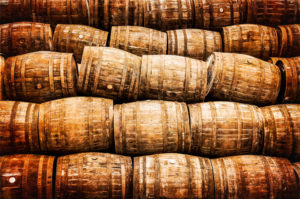
It all started earlier this summer when I read a blog posting from my friend, Al Milukas. Al publishes a blog called Live the Live and I follow it avidly. It’s a great source of information on all matters of food and drink. This story, in particular, called Aging Spirits in Oak Barrels at Home, caught my eye and interest.
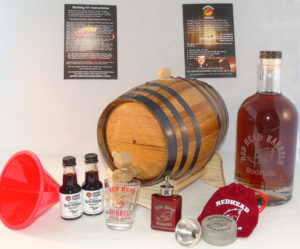
The next thing I know, I am the proud owner of a one-litre barrel from Red Head Oak Barrels and spent the next few months experimenting and aging liquor. But first, let’s talk a bit about barreling and aging spirits.
Wood, Time and Magic
Among the websites I visited about the effects of barrel aging included this with an article on the Science of Barrel Aging. As they simply put it, “Aging softens the ‘burn’ of the ethanol while smoothing out flavours and adding even more pleasant ones. The question is: what exactly is happening inside that barrel?”
They go on to talk about the effects of time, air, temperature, the role of different types of barrels (especially oak), barrel char, and humidity.
To be totally candid, I know very little about the science of barreling. Hey, I barely got through high school chemistry, so if you want to know more, I suggest you either look it up or talk to someone who knows. All I care about is the impact on my favorite libations.
Meet Red Head Oak Barrels

Following the advice of my friend Al Milukas, I ordered a 1-litre barrel from Red Head Oak Barrels and went to work.
The company is owned by Steve Mayes who was born in Baton Rouge, LA and now lives and works in the Dallas area. After playing around with the barrel and doing some experimenting (more about that in a moment), I gave Steve a call to learn more about him and his company. He started the company in 2013, is a Navy veteran, has a background in Internet marketing, and knows a good idea when he sees one. He’s also a very nice guy and could teach most major companies about customer service.
Here’s an example. In addition to my nonscientific knowledge, I’m also world renowned in my lack of mechanical and manual dexterity skills. (Just ask my wife who often calls the building’s handymen to change a light bulb.) Anyhow, I had some difficulty assembling the barrel (putting in the spigot) and contacted Read Head Oak Barrels for some help. The problem was solved immediately. I was struck by how they handled and resolved my minor issue.
When I talked to Steve we spoke about his customer service philosophy and he told me they believe in “lagniappe,” an expression in Louisiana that means “a little extra.” It’s his way of saying that they specialize in over delivering and delighting their customers. There are many companies out there selling barrels, and in fact, some are resellers using Red Head’s barrels. But, I doubt if any have Steve Mayes’ attitude and business practice.
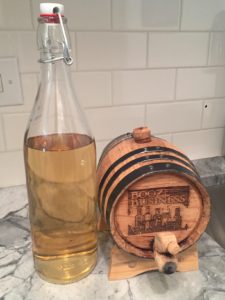
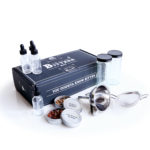
I had the barrel I bought engraved with the Booze Business logo (of course). It arrived shortly after I ordered it with very detailed instructions and appropriate paraphernalia.
The idea behind home barrel aging is pretty clear. Distilleries usually use large 53-gallon oak barrels to age their products because they need the large volume to satisfy their customers. But for home use, you need much smaller sizes. In fact, home barrels come in 1, 2, 3, 5, 10 or 20 liters and age the product inside much faster. That’s because of the ratio of wood to liquid is greater in a smaller barrel so it takes less time. That also means the taste and flavor is enhanced more quickly.
And now, the results of my experiments
I started simply and poured some mid-price rye whiskey into the barrel, waited two weeks and it was the smoothest, most flavorable rye I’ve had in a long time. Hmm, what would happen if I used an inexpensive rye? So, Old Overholt Straight Rye Whiskey went in next for about ten days and I could have made a fortune betting my friends what they were tasting was 10-year-old rye.
Gin followed and I ended up with batch after batch of outstanding barrel aged gin whose taste, color and smoothness was unbelievable. In effect, I had a barrel with complex flavors of rye, gin, and even rum.
But the coup de grace was a gin cocktail – my new favorite – the Negroni.
Last year my wife and I spent a long weekend in Santa Barbara and had dinner at the Stonehouse restaurant at the San Ysidro Ranch. We ordered Negronis before dinner and were asked if we would like a barrel-aged version. It was unbelievable.
That idea became my favorite experiment. I mixed a liter’s worth of Negroni (with Koval gin, a decent vermouth and Campari, of course), aged it for a little more than a week, removed it from the barrel into a bottle (to stop the aging) and it was great. I’ve since played with the recipe, brand of vermouth, and time in the barrel. It gets better and better.
* * *
I could end this post with any number of clichés about barrels. But I won’t. After all, I covered the subject lock, stock and barrel.
Please stop groaning.

 invited me on their radio show to discuss Single Malts and The Glenlivet. Over the years I’ve come to admire his passion for the spirits and wine industries.
 What I find most interesting is his consulting and educational training practice. In fact, when I was managing the introduction of a Mongolian vodka a few years ago, I turned to Paul for an evaluation of the brand’s taste profile and its strengths and weaknesses versus competition. What I learned was extremely helpful.
 it’s necessary to showcase whiskeys from around the world. In this case in 2016, we feature whiskeys from three nations in various subcategories to draw explicit differences. In the future we hope to have whiskeys from Canada, Japan, India, etc.”