Altaneve Prosecco

A distinctive product deals with marketing challenges

Sparkling Wine in the US has grown twice as fast as the overall wine category over the past five years. Within sparkling wine, the non-champagne segment accounts for over 90% of sales (See earlier post on Booze Business) with prosecco leading the charge.

In fact, in a recent article in Shanken News Daily:

“The Prosecco DOC Consortium recorded a 34% increase in exports to the U.S. market in the first half of 2014, with volume reaching 1.27 million cases.” 

In effect, prosecco has challenged champagne for the top of the sparkling wine domain. In so doing, prosecco has changed the occasions for drinking sparkling wine. While champagne is for celebrations and special occasions, prosecco is for everyday and any time. Further, at $12 to $15 per bottle, prosecco has an advantage for everyday use.

But, just as there are $12 bottles of wine as wells as $20, $30 even $40 still wines, can an upmarket prosecco capture a significant share of that market?

Enter David Noto with Altaneve Prosecco

David Noto
David Noto

It’s quite an interesting story. David’s family has been making wine for 10 generations in Italy and he grew up with a passion for prosecco, particularly the high quality end. So he changed his career from engineering and finance technology and brought this product to market a few years ago.

According to David, “The US market is not deeply familiar with the broad range of prosecco, so we felt it was time to introduce the best.”

In addition, the brand has an interesting story to tell. Altaneve means high snow in Italian and is a reference to the snow capped peaks of the Dolomite Mountains that can be seen from the vineyards in Valdobbiadene where the prosecco is produced. The production facility is the second oldest in the town where the production of prosecco dates back to 200 BC.

In short, Altaneve has it all, provenance, terroir, heritage and high quality. Taste? I’m a huge prosecco fan and, while I’m far from a connoisseur, I think it’s the best tasting prosecco I’ve ever had. It’s versatile (any occasion with or without food), and unlike other

Presecco production area

prosecco I’ve had, it’s consistent from bottle to bottle.

Altaneve sells for roughly $29.99 a bottle and therein is the problem.

The marketing challenge

I suppose it’s because the prosecco category in the US market is still in its infancy. Or, maybe the current image for the category is that it is generally low in price. As a result, David faces an uphill battle getting the message across that high end prosecco is worth the price. After all, all wine categories segment by price, why not this one?

I can understand the consumer reluctance to trade up. The category is still evolving and they came to it originally for an inexpensive alternative to champagne, so why pay for top shelf. That perception will change gradually over time but for producers like David Noto, accelerating a change in perception will take marketing muscle and lots of money. Altaneve is a startup brand.

The hesitation by the trade (especially bars and restaurants) is baffling to me. The mark up and profitability from Altaneve would make the brand more than worthwhile. Yet, the reluctance to change, to accept a segmentation of the prosecco category, not to mention lack of knowledge, all make it an uphill battle. To me, it defies logic.

Bottle_5I guess the bright side is twofold. First, slowly but surely, better retailers like Sherry Lehmann and important chains like Capital Grille are stocking Altaneve. Then there is David Noto himself. If you’re a follower of this blog, you know I often write about startups and the entrepreneurs behind them. Add David Noto to the list of passionate, smart and committed.

As to the Altaneve product itself, try it and let me know what you think. Unfortunately, it currently is only available in NY, NJ and CT, but also online. I’m betting you’re going to love it.

While you’re at it, check out what Wine Spectator had to say about Altaneve, as well as other info from their Facebook page.

Altaneve products
Altaneve products
Leave A Comment

Larry Ruvo: A True Renaissance Man

Distributor, Marketer, Philanthropist and an all around Mensch

Larry Ruvo, who runs Southern Wine and Spirits of Nevada, in my opinion, is the most extraordinary person in the booze business. He’s a distributor, an outstanding marketer and a philanthropist. If you Google Renaissance man, it might just as well show his picture – a person with many talents or areas of knowledge.

He started in his family owned restaurant in Las Vegas, worked as the GM of the LA Playboy Club, ran the Sahara and The Frontier, opened Caesar’s Palace and joined with Steve Wynn in starting a wine and spirits distribution company. That company became SWS of Nevada. So, most people think of him as Mr. Las Vegas.

But that doesn’t begin to describe the kind of man he is.

An intuitive marketer

The myth that suppliers (manufacturers) would have you believe is that distributors/wholesalers are a necessary burden. The law mandates them, they’ll tell you, but all they really do is move your box from their warehouse to the trade. Let me tell you, folks, in Larry’s case, nothing could be further from the truth.

When I was running US marketing at Seagram, the senior executives made biannual market visits. On the tour were the top brass, the sales guys, the finance folks and the marketing guy – me. Truth be told, I never really learned anything on these Tunnel of Love tours that I didn’t already know. That is, except for the visits to Las Vegas and the opportunity to talk with Larry about his brand building and marketing ideas. He was willing, no make that eager, to talk about what motivates consumers, bar owners and bartenders and the best ways to get a brand featured and showcased. I learned a ton from Larry Ruvo.

Did I mention gracious and warm?

I can’t remember how many Seagram sales incentive and achievement trips my wife and I took when I was with the company. But, whenever Larry and his wife Camille (whose birth date I share) were on it, we knew it would be special. Whether it was a dinner in the kitchen of an amazing restaurant in Bilbao, best places to shop in Hong Kong, lunch on the Amalfie coast – Larry knew the places to go, what to see, where to eat, how to make it more enjoyable. And, he delighted in sharing them.

Philanthropy

Larry Ruvo
Larry Ruvo

Larry Ruvo does things with passion and total commitment, so when he turned his attention to fighting brain-damaging illnesses, it’s not surprising that wonderful things began to happen.

He is the founder and chairman of Keep Memory Alive, a foundation that built and supports the Lou Ruvo Center for Brain Health in Las Vegas (also known as the Cleveland Clinic Lou Ruvo Center for Brain Health). Its mission is to treat patients with such brain disorders as Alzheimer’s, Huntington’s, Parkinson’s, ALS, and Multiple Sclerosis. Since its inception, the foundation has raised over $235 million and treated over 23,000 patients.

It all started in 1995 on the one-year anniversary of his father Lou’s death from Alzheimer’s. Larry gathered 35 friends for a private dinner at Spago to “laugh, reminisce and tell Lou Ruvo stories.” As the night wore on, it turned from an event to honor his father to a call for action to defeat the disease that took his father’s life. They raised $35,000 and the foundation was born.

The biggest challenge was being taken seriously since Las Vegas is not top of mind for world-class health and wellness facilities. But, in the last 10 years, thanks to Larry’s marketing, packaging and brand building skills, it has become just that.

Clinic
Cleveland Clinic Lou Ruvo Center for Brain Health

To meet the challenge, he created the Power of Love Gala in Las Vegas and raised money to fund his plans. He convinced Frank Gehry to design the building and it is  truly amazing. Next he signed a deal with Cleveland Clinic to operate it. But, he also needed a super star to run it. So he turned to Cleveland Clinic and said, “I’m giving you Yankee Stadium… I want Babe Ruth.” What he got was Dr. Jeffrey L. Cummings, a world-renowned leader in research and treatment of brain disorders.

That’s what happens, my friends, when you mix determination, passion and marketing skills.

His foundation, Keep Memory Alive and the Cleveland Clinic Lou Ruvo Center for Brain Health, holds an annual fundraising event in Las Vegas. It’s called The Power of Love and in the past has honored Mohammed Ali, Quincy Jones, Sir Michael Caine and many others.

This year’s event is on October 11 and is billed as an evening with Michael Bublé. You can find out more at here.

When Larry Ruvo sets his sights on something, great things happen.

LR 2

Leave A Comment

The Columbian Exchange Part 2

What influence has it had on international alcohol beverages?

(The earlier posting on the Columbian Exchange generated a great deal of comment and emails and I invited Mr. Desmond Nazareth of Agave India Industries Pvt. Ltd to share some further thoughts on the subject. So, here is a guest blog posting from him. In this article Desmond introduces a wide array of local alcohol products from around the world, some of which were new to me.)

The Columbian Exchange between the so-called ‘Old’ World (mainly Eurasia) and ‘New’ World (the Americas) was more than an ‘event’ – it was a ‘process’ that started in the 16th century and continues in a more generic sense even today.

In this guest blog, I would like to discuss the impact of this Exchange process on international alcoholic beverages and, make some suggestions for ‘opening up’ alcobev categories.

Fermented beverages across the world

business_1100010245-012914-intContemporary scholarship tells us that up to the 12th century AD or so, most cultures around the world consumed various forms of naturally fermented beverage. These were typically what we today call ‘wines’ (fermented grapes, fruit and berry juices), ‘beers’ (assorted cooked and fermented grains), and fermented natural sweet liquids (fermented palm sap, agave sap, nectar from flowers, honey).

The introduction, and role, of distillation

In the Old World, using various fermented beverages as their substrates, distilled (and infused) potable alcohol began around the 12th century AD, giving rise to the plethora of ‘spirits’ and ‘liqueurs’ of today – the technique used initially was ‘pot-still’ distillation and later included ‘column’ distillation.

The New World knew nothing of distillation techniques until the 16th century AD, when it was introduced there by Old World colonizers.

With distillation being part of the technology that featured in the Exchange, it was applied to the variety of fermented beverages in the New World, including those made from ‘dramatis botanae’ that were local, and others that came with the Exchange.

Among the botanical species introduced to the New World, sugarcane (and the by-product, molasses) was by far the most important – the basis for light and heavy rums. Grapes, of course, became the basis of countless ‘local’ New World wines and spirits.

Species introduced to the Old World included cashew, potatoes, sweet potatoes, cassava, agave and corn – cooked and fermented, either alone or in combination with other local substrates (and sometimes a substitute ingredient), these became the basis of so-called ‘local’ distilled spirits.

Cashew fruit
Cashew fruit

The advent of claims for ‘local’ beverages: GIs, AOs…

In today’s world, various regions and countries lay claim to a ‘privileged’ status for a variety of  alcoholic beverages, with the recent introduction of ‘international trademarks’ in the form of Geographical Indications (GIs) and Appellations of Origin(AOs), which are protected by the WTO and affiliates. Examples of these abound: Scotland’s ‘Scotch’, USA’s ‘Bourbon’ , Mexico’s ‘Tequila’, Brazil’s ‘Cachaça’, Goa’s ‘Feni’, etc.


Consider some ‘local’ alcobev that resulted directly from the Columbian Exchange:

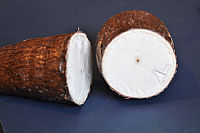
Cassava plant, an edible starchy tuberous root.
  • grape based ‘pisco’, with Chile contesting Peru for ‘ownership’
  • grape based wines in California, Chile, Argentina etc.
  • grape based spirits like ‘singani’ in Bolivia
  • cashew apple based ‘feni’ in Goa, India
  • agave based spirits in India
  • molasses and sugarcane based rum and cachaça in the Caribbean, and South america
  • cassava based spirit in sub-Saharan Africa
  • single-malt whisky in Brazil, Japan and many other countries
  • potato based ‘horilka’ in Ukraine, vodka in Poland and Germany, ‘akvavit’ in Scandinavia, ‘poitín’ in Ireland, ‘tuzemák’ in the Czech Republic
  • rye based whisky in Canada
  • sweet potato using ‘soju’ in Korea & ‘shōchū’ in Japan
  • the list goes on…

Now, in none of these countries or regions can one say that they produce only the product whose ‘localness’ they are trying to protect – in general, a variety of alcoholic beverages ‘originating’ from all over the globe are made ‘locally’ in most other parts of the globe.

In an increasingly connected, globalized world, does this sort of ‘protectionism’ make sense?

The question raised by Agave India

India -- Deccan Plateau
India — Deccan Plateau

A case in point is the artisanal, small batch agave spirit that Agave India officially makes in India (since 2010), from blue-green agave that has been growing ‘locally’ on the Deccan Plateau for at least one hundred years. We would like our agave spirits to compete internationally with agave spirits made in Mexico – but the international competitions recognize only ‘Tequila’ or ‘Mezcal’ and do not allow us to compete within those ‘protected name’ categories. We’ve tried to make an argument for a larger category, ‘Agave Spirits’, in which ‘Indian agave spirits’ can go up against ‘Mexican agave spirits’, but so far to no avail.

We also make an artisanal, small batch sugarcane spirit in India, that we call ‘Pure Cane’ – but we cannot compete with ‘Cachaças’ in their category for the same reasons – should we not have an international category of ‘Sugarcane (or Cane) spirits’? It would make the many international producers of fine cane spirits happy to be recognized.

Perhaps, one day, globalization will remove meaningless barriers and productive exchanges of all kinds will take hold – some of which have very ancient geological and human histories.

(Acknowledgements: to the amazing, globalized and free resource that we know and love: ‘Wikipedia’)

Thank you, Desmond.

Desmond Nazareth and an Indian Agave plant.
Leave A Comment