Craft Confusion

When is the term ‘craft’ authentic and when is it marketing hype?

Craft StillThe spirits industry has seen amazing growth of craft distillers and brands. The Distilled Spirits Council of the US (DISCUS) has reported that there are nearly 730 “small” distilleries producing 3.5 million cases in 2014 (up from 700,000 in 2010) and with revenues of nearly half a billion dollars.

This craft spirits development is here to stay based on a number of factors including the interest in whiskies of all types; consumer trends regarding connoisseurship, craftsmanship and artisanal products in general; the focus on ingredients, process, and the distiller; and, attention to what’s in the bottle.

There are other forces at play here, particularly the rejection of mass-produced products in favor of small batches and hand crafted. A phenomenon affecting all consumer businesses from packaged goods to durables.

So it’s not surprising that the power of the words, “craft” “handmade” “small batch” would be adopted by large brands and used despite the intent of these words. When a brand sells hundreds of thousands or millions of cases, one needs to wonder whether the use of these words is marketing hype (as in “smooth”) or outright fraud. At the same time, there are also small distillers jumping on the bandwagon without the real credentials.

The lawsuits

The best and most succinct coverage of what is going on is to be found in the Feb 16, 2015 edition of Wine & Spirits Daily, under the headline, Truth Squad Discusses Transparency in Labeling Lawsuits. The “Truth Squad” is a panel of WSD readers (manufacturers and wholesalers) who express their professional views on a range of issues affecting the wine and spirits businesses.

There are a number of cases involving court action related to labeling:

  1. Templeton Rye was sued for claiming it was made in Templeton, Iowa when in fact it is made in a large multi-brand distillery. The implication was that the brand was a small batch product. They have since revised their label.
  2. Tito’s Vodka is being sued in California and Florida for the label claim that it is handmade as in, Tito’s Handmade Vodka. At roughly a million cases, how can you call yourself handmade? Unless, of course, you count turning on
    Tito's label
    Tito’s label

    the lights as part of the process.

  3. Maker’s Mark is also being sued for claims related to “handmade.” According to USA Today, “The lawsuit…accused the distillery of deceptive advertising and business practices with its “handmade” promotion on the labels of its bottles, known for their distinctive red-wax seal.” I know that they hand dip each bottle in the wax but can you totally hand make 1.3 million cases?
Maker's Mark
Maker’s Mark

Don’t get me wrong… I think these are outstanding, well-made products. I’m a fan of each of them but the words in question are not marketing hype words like “smooth” or “premium.” To many people, the misuse of these words appears to be deceitful.

Enter the Truth Squad

One member thinks too much is being made of this issue and suggests that the consumer doesn’t know or care. Maybe. But, how about the genuine small batch or craft distiller who has invested their life savings in a distillery and whose livelihood depends on it?

Another view was that it’s the lawyers “who make a fortune” with spurious lawsuits that are behind it all. Perhaps. People who are looking for the real deal deserve not to be cheated with misleading claims. And, if the regulatory people won’t deal with it, then the courts should.

A distributor executive put it nicely when he/she said,

“I think that the average consumer feels better about purchasing something with the perceived or real support to a small company, and dislike it when they find out it’s just part of a huge corporation. It would be…like someone buying… produce at a big box store, and then taking it to the Farmer’s Market on a Saturday wearing overalls, and making money on the perception that they are a farmer.”

What’s the answer?

Simply put, there needs to be a standard by which those using of the word ‘craft’ (and related phrases) are held accountable. Don’t expect the alcohol governing body (TTB) to do it. Even if they were so inclined, they don’t have the resources to police these types of label claims. For the same reasons, forget about the Federal Trade Commission.

I think the craft distillers associations like American Distilling Institute or American Craft Spirits Association should tackle this but, for whatever reason, seem to be disinclined to take a stand.

But, a fledgling craft organization seems more than willing to provide a solution.

Robert Lehrman, an alcohol industry attorney (Lehrman Beverage Law) together with a number of craft distillers has formed the Craft Beverage Association and its mission is to tackle this subject. This is from their (in development) website:

The Association was formed to try to find a way to set standards for the seemingly simple, yet hitherto amorphous and elusive — but fundamentally important term: craft.”

What they have in mind is analogous to the Good Housekeeping Seal of Approval or the Certified Organic Label. Their mission is: “To set craft standards for beer, wine and spirits, in a fair, modern, flexible, enforceable way, so the term can be filled with meaning and saved from abuse, for the benefit of consumers and craft beverage producers everywhere.

*     *     *

There’s a major shift occurring in the beer and spirits industries and it’s called craft and/or handmade and/or small batch. Large manufacturers have lots of options as to how to deal with this growing consumer interest. They can ignore it and present the merits of their brands as is. They can attack it, like Budweiser’s advertising. Or, they can buy legitimate craft-made brands, then screw it up, again like Budweiser. But to co-opt or misuse these terms is just plain wrong.

I prefer the industry to clean its own house but, until then, I guess we’ll continue to make the lawyers rich.


Handcrafted Sorel --  Jack From Brooklyn.
Handcrafted Sorel — Jack From Brooklyn.
Leave A Comment

The State of the Spirits Business

What’s behind the continuing growth of liquor?

Last week the Distilled Spirits Council of the US (DISCUS) presented its 2014 Market Report, which indicated that discus_logospirits (liquor) sales were up 4% to $23.1 billion and volume grew 2.2% to 210 million cases.

In addition, market share versus beer increased for the fifth year in a row. Overall, spirits sales share went up 6.4 points since 2000 to over 35% of revenue. Most interesting to me, supplier revenue in 2014 just about doubled from 2000. Sales went from $11.7 to $23.1 billion.

The DISCUS release went on to report a number of factors contributing to the industry growth, all of which make sense. However, I have my own take on the factors and trends that are driving liquor sales and they can be best summed up as changes in consumer attitudes and behavior.

Changing consumer taste preferences

Let’s take a brief trip down drinking memory lane.

From the 50s to the 70s, whiskey dominated drinking preferences. The ‘silent shudder’ that came from the first sip of an American or Scotch whiskey was worth the effort “once you got used to it.” From the 1980s to the 2000s, consumers stampeded away from whiskies into vodka, the ubiquitous alcohol that provided the kick but mixable with almost anything that masked or camouflaged the taste.

24875266_sOver the last ten years, a new generation of drinkers has turned to whiskey for its perceived greater depth of flavor and its newfound mixability thanks to the cocktail resurgence. (By the way, that desire for taste and depth of flavor is what is also driving the craft beer growth.)

Also, the vodka suppliers shot themselves in the foot with the flavor explosion that went from the sublime to the ridiculous; from citrus to esoteric, from serious to such choices as whipped cream and marshmallow. (See a previous posting on vodka.) The result has been the ability to purchase over 600 flavors and slower growth. Vodka sales are underperforming the overall spirits category as a new generation of drinkers goes back to what their parents or grandparents had rejected.

What’s in the bottle and how did it get there?

This new generation has brought with it a conversation about the craft of making spirits and, like many changing values, 29949289_mit has spread to other age groups. While once upon a time consumers focused on the alcohol effect, today the focus is on ingredients, process, the distiller and artistry among a host of other manufacturing factors.

In short, some categories of the spirits industry are becoming much like the wine business and craft beers with an emphasis on quality, taste and small batch production. In fact, DISCUS reports that small distilleries grew from 92 in number in 2010 to 700 in 2014 and from 700K cases in volume to 3.5 million today.

It’s not about mass production or even consumption. Quality rules. Are you listening Smirnoff and Budweiser? Run all the clever ads you like, you won’t stop this trend.

Women and whiskey

Let’s take another trip down memory lane. Once upon a time, whiskey was the domain of men and distillers tended to 33892845_mshy away from marketing and advertising toward women. It wasn’t until 1987 that DISCUS lifted a voluntary bam on advertising directly to women. In a recent article in Huffington Post, Meghan O’Dea of The Whiskey Women had this to say, “We’re seeing a move toward gender-neutral drinking.” (Check out her website, it’s interesting. The home page has this slogan, which I just love, “Fill your mother’s crystal decanter with your father’s drink of choice.”)

I think the days of “girl drinks” are over. And, I think that the recent tutti-frutti direction in vodka is a contributing factor. Again according to O’Dea:

Women are consciously realizing that the beverages you enjoy have a lot to say about who you are as a woman…women are shying away from drinks that infantilize them.”

Clearly, whiskies have benefited from this change in attitude and, while flavored whiskey may have played a role, it’s by no means the sole driving factor.

(For an interesting historical perspective on women and whiskey, see this article from The Denver Post.)

The outlook

George Washington Distillery

With more positive attitudes toward spirits consumption among consumers, I expect that the growth of the category will continue. DISCUS does a good job in promoting market access and helping to change archaic purchase laws. After all, how do you tell the public that state after state is legalizing marijuana but you can’t buy liquor on a Sunday?

Leave A Comment

Last Drop Distillers

Old Whisky, New Management

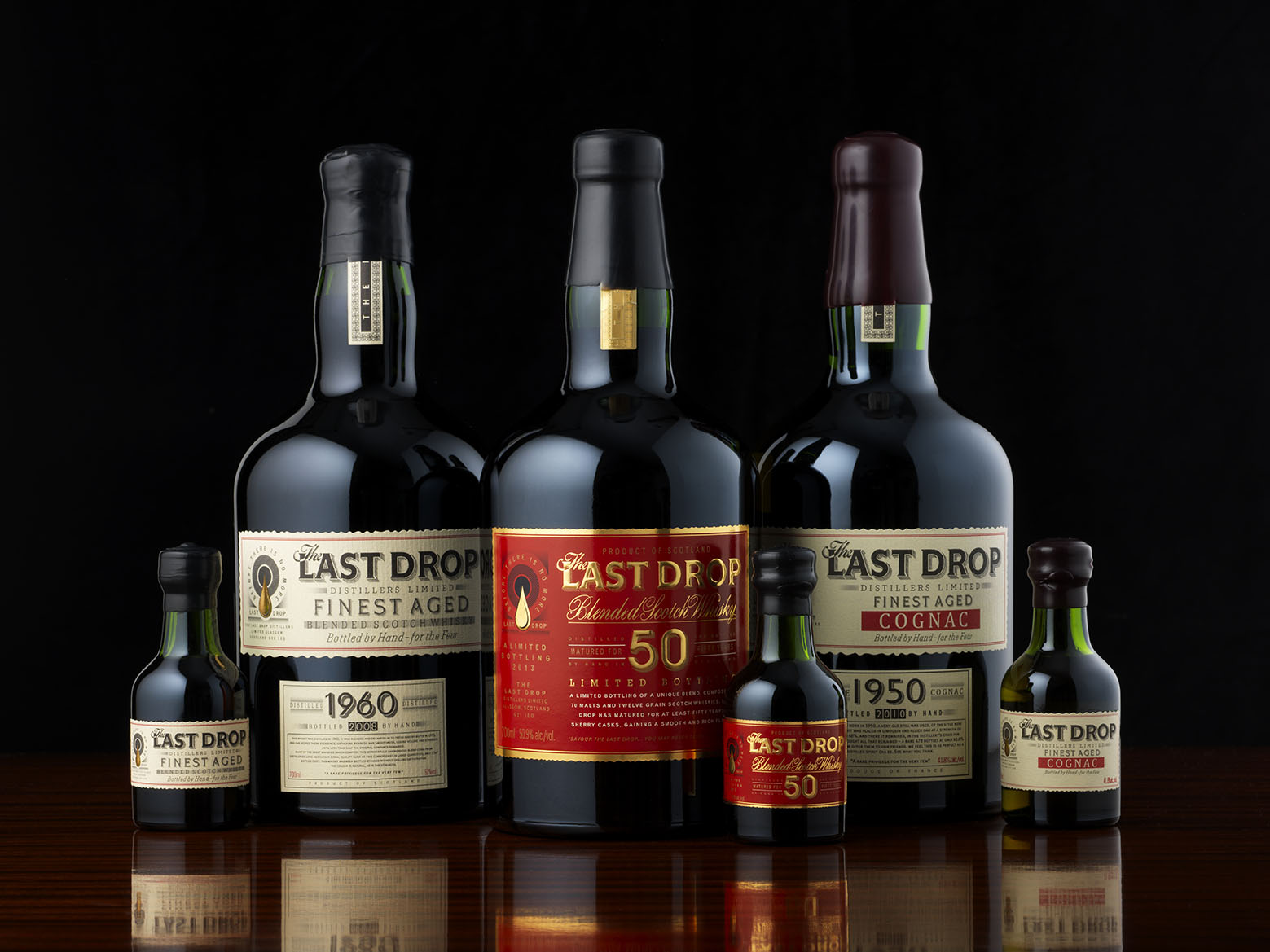
Last Drop Distillers products
Last Drop Distillers’ current products

At the 21st Annual Whisky Advocate Awards, The Last Drop 50 Year Old Blended Scotch Whisky was awarded the highly prestigious Whisky Advocate’s Blended Whisky of the Year 2014.

It’s a remarkable product from a unique and equally remarkable company. I’ve blogged about the company a number of times but only in reference to James Espey, one of the founders. I think you’ll find the full story very interesting, particularly since the day-to-day management of The Last Drop Distillers (LDD) has been handed over to the daughters of two of the founders.

How it began

In 2008, three partners with a proven track record of producing incredible spirits brands (Johnnie Walker Blue Label, Chivas Regal 18 Year Old, The Classic Malts, Malibu and Baileys Irish Cream) decided to pool their skills to create one last amazing brand. So, James Espey, Tom Jago and Peter Fleck founded the company whose single-minded goal was to find and bottle rare and exclusive spirits.

Award winning Last Drop 50 year old

For instance, The Last Drop 50 year old (50.9% AbV, $4,000) is based on the discovery of three overlooked casks that had been distilled between the 1940s and 1950s and sold throughout the 1970s. But somehow these casks were ignored or forgotten about until Espey and Jago came along and further aged them.

The result was twofold. The whisky was extraordinary and described by reviewers as “epic.” Further, they realized they were on to something and have produced a 1960 Scotch and a 1950 Cognac. Other last drop variants are in the works.

New management

As you can imagine, precious and rare spirits, not to mention expensive, require a full time commitment for sales and marketing. As a result, the management torch has been passed to two brilliant offspring of the founders.

Carolin (Beanie) Espey

Caroline (Beanie) Espey (daughter of James Espey) is Sales and Marketing Director and comes with a strong global background as well as expertise in very top shelf brands. Following a degree in modern languages at Oxford University, Beanie has worked for luxury brands Chanel and L’Oreal before starting her own business – a Marketing agency run jointly from London and Hong Kong.

Rebecca+Jago.jpeg
Rebecca Jago

Rebecca Jago (daughter of Tom Jago) is Creative Director. Following a degree in Linguistics and time with some of London’s leading design agencies, Rebecca has been running her own small design agency for the last 25 years. Somewhat unusual for a creative director inasmuch as Rebecca’s creativity extends both to design and product.

What makes The Last Drop unique?

There are many very expensive whiskies on the market selling for four, five, even six figures. (Here is an interesting list.) The scotch whiskies on the list are mainly single malts and available in either glitzy or straightforward packaging. What I love about The Last Drop products is that it is about the liquid, not the packaging. If your motivation is ostentation, then you probably gravitate toward elaborate packaging that shows your “good taste” regardless of the quality of the scotch.

Also, the list consists mainly of single malts except for Last Drop Distillers 1960 Blend and Johnnie Walker Blue 200th Anniversary Blend. While I love single malts, there is nothing like a carefully blended scotch, particularly with ancient stocks. For me, that’s the epitome of the scotch maker’s craft.

Add to that a family run business consisting of old school/new school spirits industry connoisseurs and the results are products worth buying.

Of course, that’s only as long as the stock lasts. But, if I know the Espeys and Jagos, more discoveries are on the way.

IMG_3547
The Last Drop team


Leave A Comment