
Stop and Smell the Rosé

The Much Maligned Rosé

I was visiting some liquor stores and wine shops recently and noticed lots of displays featuring rosé wines, which I love. Unfortunately, I don’t know much about rosé and, frankly neither did the salespeople I spoke with.

In fact, as I pursued trying to increase my knowledge, the so-called mavens I know weren’t that helpful either.

So, here I am, a wine drinker who loves rosé and I’m surrounded by myths and misinformation.

I set out to rectify the situation and here’s what I’ve learned so far.

(Feel free to chime in with comments or send me an email.)

Popularity
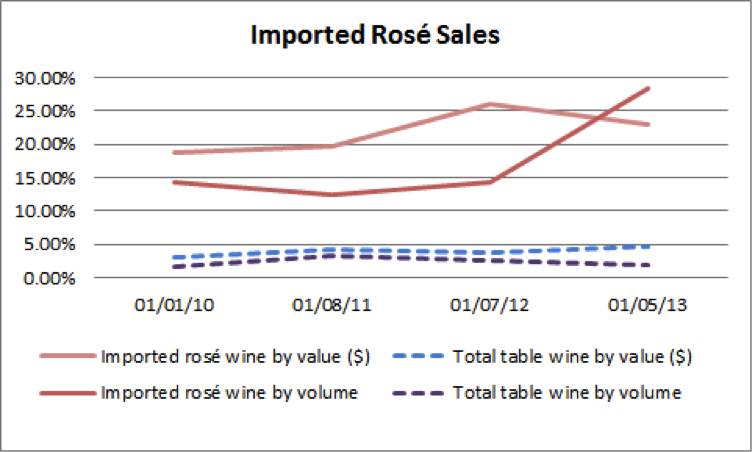
Nielsen Data. Sales of imported rosé table wines.

I learned that I’m not alone in my preference and adoration of rosé. The most recent data I saw indicated that imported rosé sales are growing sharply. In fact, an article in the May 5th Examiner has this to say:

“While drinking pink wine (at least publicly) was previously relegated to newbies quaffing White Zinfandel and other sweet blush wines, today’s rosés run the gamut in hue and are primarily dry in style. With a decade of growth in the U.S. market, rosé continues to be one of the U.S.’s fastest growing wine categories in retail sales; the message is clear: Rosé is here to stay.”

So there… I am not alone. I also will bet that like me, drinking rosé goes beyond just the summer, picnics and barbeques. Those of you who sass rosé can just stick it you-know-where. (Hint – it rimes with sass.)

Myth: Mixing red and white wine together is how you make rosé.

Ha. If you believe this then please leave this blog.

Lightly crushing red grapes and macerating the liquid with the skins for a period of time makes rosé. The juice is strained from the solid stuff to create a “must” which is then fermented in tanks.

The longer the grapes’ skins are left sitting in the wine, the darker the color. That’s why there are many shades of rosé.

Rosé wine colors --depending on how long the skins are left in the wine.
Rosé wine colors –depending on how long the skins are left in the wine.

Other Factoids

I came across an interesting article on Buzzfeed about rosé with some interesting “things you need to know.”

Such as:

Rosé can come from anywhere in the world but generally old world rosé will usually be drier and new world rosé might be less dry. While I love all types of rosé, I’m especially fond of those from Provence, France.

With rosé the newest vintage is the freshest so don’t be skittish about drinking it young. You won’t find anything dated more than two or three years ago and, forget about hoarding it in your cellar. Rosé is meant to be consumed young and that’s reflected in the price, which means there are great options in the $15 range.

Oh, and finally, about barbeques…while rosé is not meant only for those events, it is great with food you grill outdoors.

There you have it, a layperson’s learning about rosé. I have to tell you that writing this post has made me very thirsty. Also, I intend to scour the Internet for rosé tasting events.

Do you know any?

Stay tuned.

nuit-rose-sunset
A glass of rosé and a sunset. What could be better?


Leave A Comment

From Ballet to Booze

Meet Allison Patel, a whisky-loving woman and former ballerina.

Allison is the owner/producer of her own whisky, Brenne, a French Single Malt made in Cognac, France. She reinvented herself into the booze business as a second career after hanging up her tutu and pointe shoes.

Brenne_Pouring
Brenne whisky, an incredible product.

I am very glad she did – trust me when I tell you it’s a terrific world-class whisky. It’s very unique, smooth and approachable.

Here’s the product story:

Brenne is made from estate-grown barley and is harvested, distilled, matured and bottled in Cognac, France. The expertise in distilling comes from a 3rd generation craft distiller. As Allison describes it, “It’s crafted from seed to spirit.” The taste is extraordinary and is a result of the malted barley and the barreling. Brenne Whisky starts in new Limousin oak barrels and is finished in Cognac casks, giving it a slight hint of fruit that sets it apart from other whiskies. Each bottle comes from a single barrel selected at its peak. Brenne was officially launched in October 2012 but only after many years of developing and maturing her product. So, add patience to Allison’s skill set.

Allison’s story is no less interesting:

She and her husband have always shared a passion for food and drink from all over the world. Making an effort to visit local markets, wineries, and distilleries in their travels, they have developed an appreciation of great taste experiences, especially with their favorite category — whisky.

1006096_588165134613666_3489407826781683562_n
Allison Patel with Brenne whisky

After failing to find many “non-traditional” whiskies in the US, Allison took it into own her hands and started setting up an import/export company for this sole purpose. Allison is a most interesting person with drive and tenacity, mixed with charm and humility. She launched a brand and still managed to maintain a balanced view of her efforts. One chat with Allison is all it takes to feel great about the future of the spirits industry. From Allison’s personal blog, The Whisky Woman, about being a booze business startup:

This is not an easy road at all.  Naturally, I only share publicly the highlights of this journey, but I tell people who are thinking about starting their own brand in the spirits world to not be fooled by the happy-go-lucky social media sharing; everything looks easier then it seems, even the stuff that looks impossible.  But… the moment when you start to realize your dream is becoming a reality is unlike anything else.  Its deep, exciting and can rock you to the core.

I guess that dancing on your toes is good training for the booze business.

By the way,

She and another new and exciting booze business entrepreneur, Jack Summers (Sorel Liqueur), often team up for joint promotion opportunities. In fact, it was Jack who introduced us and recently introduced me to a Brenne and Sorel cocktail called The Last Call. We’re talking amazing here, folks. (Recipe: 2 oz Brenne, 1 oz Sorel, let it rest and breath for a minute.)


Image
Allison Patel and Jack Summers enjoying the fruits of their labor — The Last Call. Photo credit: Christina Soto-Chimelis
Leave A Comment

Smirnoff Ad: The Deconstructed Martini – What do you think?

Bartender or Mixologist

Well, it was bound to happen. For some industry pundits and aficionados, the term ‘mixologist’ is another term for a bartender or, as some put it, a bar chef. But, for many in the industry, the term mixologist is off-putting and the preference is for bartender.

Ray Foley, founder and publisher of Bartender Magazine  has this to say about the different terminology:  “A mixologist is a person who really doesn’t know how to tend bar but has the money to get a PR agent.” Whew, that Ray, such a kidder, always holds back his opinions.

The Smirnoff Ad

A friend in the industry alerted me to the Smirnoff ad that seems to agree with Mr. Foley. According to Adweek, “With the tagline ‘Exclusively for everybody,’ Smirnoff spends most of the ad mocking all things VIP, while also taking quite a few digs at the mixology movement, represented by a Stockholm-educated neckbeard who curates his herbs and deconstructs martinis.” (Neckbeard?)

Here is a link to the Smirnoff Vodka Deconstructed Martini ad, in case you can’t view it below.

So, I have two questions:

For Diageo (owner of Smirnoff) – the ad is clever and very well done. But, you’re poking fun at pretentiousness (which is very cool) so aren’t you biting the hand that feeds you? Aren’t you the people who’ve been pushing the term mixology? If the answer is yes, good for you.

And now dear reader – what do you think of the ad?

(My thanks to Robert Lehrman and John Messinger of Bevlaw.com for bringing this to my attention.)

Leave A Comment