From a job to a career
The last 30 years in the booze business has seen fundamental shifts in all aspects. The industry has consolidated at all levels: manufacturer (supplier), distributor, and retailer. Consumer preferences have gone from whiskies to vodkas and back to whiskies. Mass-produced brands are losing ground to craft and micro distillers. The cocktail has reemerged with a vengeance.
Consider the arguably most important person in the drinks business chain, the influencer, the gatekeeper of choice – the bartender. In my view, there are profound shifts in motivation and aspiration that has changed the nature of bartending and the people who work that craft.
My friend Gaz Regan, in a recent interview with Tales of the Cocktail, summed it up nicely when asked about the changes affecting bartending. He points out that, so far as he is concerned, the changes began about ten years ago. “Bartending prior to that was a part-time job. Something you did until you got a real job.”
He went on to add:
“What happened was, the spirits companies began to recognize the value of bartenders. They started having [drink] competitions with big prizes, and investing money in bartenders. Giving bartenders jobs as brand ambassadors followed that. And, in return, the bartenders gave the spirits companies the exposure that they were looking for. So that’s been a fabulous marriage. I get asked sometimes, is this all going to go away? My answer is, not as long as the spirits companies are making money.”
In the past…
Some of my theatre friends have an interesting expression. “A bartender is an actor that doesn’t want to become a writer.” That’s the way it was, once upon a time.
To oversimplify, there were some basic and simple motivations. Some entered bartending as a ‘day job’ in order to pay the bills while they pursued their ambitions and life’s dreams. Others were professional bartenders whose joy, in addition to a paycheck, was the challenge “behind the stick” and in meeting and interacting with (hopefully) interesting people.
The job choices ranged from the corner bar to the lavish watering holes of the rich and famous. The lines between ‘job’ and ‘career’ were blurred.
Today…
While bartending is still a job to many it’s no longer seen as a way station on the path away from the booze business. On the contrary, it is more often than not seen as the launch of a career in the hospitality industry in general, and alcohol in particular.
Goals and aspirations are changing and here’s how the bartending profession is evolving.
- From bartending to bar chef
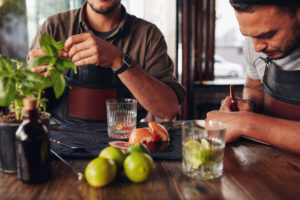
Think about the changes in the culinary and food arts world. Cooks have become chefs, who in turn, have become celebrity chefs. This journey in the bartending world, thanks to the cocktail culture, has elevated the art of bartending – from bartender to mixologist to bar chef.
Regardless of the level, it’s an exciting time to be behind the stick with the craft moving beyond, “what will you have?” to “try this.” Back to Gaz. When asked what excites him about the current generation of bartenders, he had this to say:
“The creativity. The fact that they have gone so far, with [things like] molecular mixology, that has created a space for artistic people to choose bartending as their way of expressing themselves. So we’ve got more and more artistic people behind the bar, and I think that just keeps progressing and progressing and progressing.”
- Brand Ambassador
Back in the day at Seagram, we recognized the importance of the brand ambassadors but we looked at it from the consumer’s perspective.
We hired a (former) whisky writer, dressed him in kilts, made sure he could play the bagpipe, and sent him on his way to travel the country. With considerable gusto, he entertained and lectured consumer audiences on the basics of Scotch whisky and conducted tastings of Chivas Regal and/or The Glenlivet.
Around the same time, Diageo introduced the Masters of Whisky education program. This was aimed at consumers (at whisky festivals around the country) and, importantly, provided training to bar and restaurant staffs. (Unfortunately, this highly successful and groundbreaking program has just been unceremoniously dropped with lots of Diageo double talk about how it will become a better program in the future. Trust me, it was a terrific program and will be missed.)
In effect, for the past few decades, suppliers have realized that to generate interest in their brands and products, they need to capture the hearts and minds of the key influencer and gatekeeper, the bartender. Who better than another bartender? And so, another career path became available to bartenders.
This from Tales of the Cocktail sums it up nicely:
For bartenders looking to move on from behind the bar, becoming a brand ambassador can be a shrewd, lucrative step forward in their career, a graceful way to avoid the late nights and constant physical labor of bartending while still remaining in the industry.
The drawback? Not a lot of jobs out there for this niche, and thanks to Diageo, lots of people will be looking for new jobs.
For those who enjoy and excel at a brand ambassadorship, the opportunity to expand into a spirits company can be a likely further step in career development. Particularly, since major companies are beginning to understand that brand success and even revitalization comes from the bar trade and the people who know it well.
- Becoming the boss
Upward mobility and career advancement is not solely in the domain of the desk bound.
I suppose this aspiration has always been there, but I notice more and more that bartenders I know and meet have become creative directors, bar supervisors and/or Food and Beverage Managers. As multi-unit establishments expand and grow, the need for qualified leadership will also grow.
The key ingredients are a passion for the food and beverage industry, managerial skills, and for some, an advanced degree. Above all it helps to have a mentor and a work environment that nurtures and rewards business talent.
Pam Wiznitzer, Creative Director of Seamstress, and president of the United States Bartenders’ Guild – New York Chapter, is a good example. Here is her story from a recent Forbes online article.
- The entrepreneurial spirit
Opening one’s own bar is a risky proposition, with compounded risks if food is part of the equation. Tough, but not impossible, assuming the financial and managerial resources are in play.
However, the entrepreneurial path is not limited to opening an establishment. Read the Simon Ford story. His journey went from brand ambassador (international no less) to Director Trade Marketing (at Pernod Ricard) to Cofounder at The 86 Co.
If opening a bar is risky then launching a distillery is, well, perilous. And yet, many try and some succeed. In addition to financial resources, it takes training, patience, long hours, and people skills.
Just like being a bartender.
* * *
In the weeks and months ahead, I plan to highlight and focus on this new breed of people behind the stick. In the meantime, if you think of anyone I should think or write about, let me know.