Why Bother Advertising Alcohol? Adweek has the answer.

Unknown

Lauren Reeves, who is a comedian and comments on advertising in AdWeek, recently asked this question.

Along the way, she provides a very funny analysis of four different vodka ads. The ads include Grey Goose, Wodka Vodka, Russian Standard and Smirnoff.

Of the four, Wodka has received the most hits on YouTube and is very clever. It’s what often is referred to as good advertising, poor brand sell.

Check out the ads and see what you think. (Come on… you’re working way too hard, you need a diversion.)

Let’s start with Lauren Reeves at Adweek.

Now take a full look at the ads by Grey Goose, Wodka Vodka, Russian Standard and Smirnoff.

Which is your favorite?

I have to tell you – I think any of these are better than the beer ads I’ve seen lately.

(Special shout out thanks to Mike Molnar, Managing Partner at Glow for bringing the videos to my attention.)

Leave A Comment

Jägermeister Enters a New Era

Jägermeister Spice Bottle Image High-resJägermeister, a brand icon for decades, has just introduced a product extension called Jägermeister Spice. The product combines vanilla and cinnamon spices with the original Jägermeister ingredients. It will be available nationally in limited quantities starting this month.

Interesting – a limited edition spirit product. Wonder what they have in mind?

Regardless, from the handful of people I asked to taste the product, the results were very positive. “It’s perfect for this time of year…it’s like eating a holiday spiced cake.” One woman described it as “Jäeger’s softer, kinder relative.”

I think they have a winner here. It’s easy to drink; fun tasting and can go wherever the original product goes in those special Jäger occasions. But, the appeal moves it further along in the drinker’s repertoire. In that regard, the folks at Jägermeister have stayed true to the cardinal rule of product extensions – “feed the brand, don’t eat the brand.” In other words, I think it will bring new users, lapsed users and new occasions to the franchise. All without alienating those original round of Jäger shots moments.

As to the limited edition aspect, the company says that this first ever product extension will be limited to 100,000 cases this winter. The brand sells around 3 million cases so it’s a drop in the bucket.

Why limited edition?

One cynical industry observer thought that if the extension doesn’t work, they wouldn’t damage the base brand. It will just disappear. I’m not buying that.

I think that the best way to grow a franchise without denigrating the core audience is to periodically introduce seasonal or other temporary variations that – pardon the expression – spice things up and adds innovation to the mix. Perhaps we can expect a spring or summer variant. Or, maybe Spice will stick around.

Adam Rosen, EVP Marketing (and a smart, innovative one at that) summed the effort up –

“Jägermeister Spice offers both new drinkers and our longtime fans an innovative product that can be enjoyed in any setting. Whether served neat or mixed with cola, Spice offers new experiences and drinking occasions while delivering the same quality spirit that Jägermeister is known for.”

Looks like Jägermeister Spice is about to join the holiday festivities.

Leave A Comment

Beer Business Blues

The media, both consumer and alcohol industry trade, has been chocked full of stories about the decline and potential demise of beer.

In addition to stories in Beer Business Daily, Buffalo Trace Newsletter and others, notable consumer publications have also had much to say on the subject over the past two weeks. Check out these headlines:

The Atlantic: Why Are American Drinkers Turning Against Beer?

USA Today: 6 sobering reasons why beer makers should worry.

Slate: The Stunning Collapse of Beer in America

Now it’s my turn. What’s the problem? Why is it happening?

What’s the problem?

It all started with the Gallup poll on what Americans drink and prefer. The annual survey revealed two startling facts. First, Americans who drink alcohol are equally likely to say they drink wine and beer most often (35/36% for each type). No big deal, right? But if you go back to 1992, it was 47% for beer and 27% for wine. So, since 1992, beer as a beverage of choice has significantly declined.
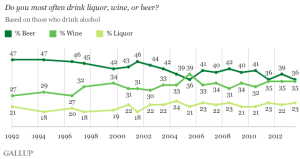
Gallup chart

The second problem, and the driver of the overall situation, is that young adults’ booze preferences have shifted away from beer toward wine and liquor.
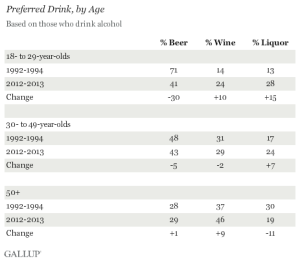
AgeXType

Why is it happening?

I’ve read dozens of explanations in the press and perhaps as many as hundreds of ideas from readers of this blog. So far as I’m concerned, the reasons have to do with 1) too many choices in and out of beer and 2) changes in alcohol drinking demographics and attitudes.

Let’s start with number two and use liquor as an analogy. When I entered the spirits and wine business in the late 1980s, there were enormous earthquake-like shifts in drinking patterns. The whiskey preferences of the Mad Men era had given way to the surge in white spirits, led by entry level drinkers no longer interested in mimicking the behavior of the past. So, whiskey went away for a while and has only recently begun to return.

In short, changing demographics result in changing values and attitudes and now its beer’s turn. It’s a mistake to assume that the drinking preferences of the past will continue with a new generation.

But wait, there’s more. The real culprit in shifting preferences away from beer is that there are too many choices. From outside the category, the spirits and wine manufacturers have been concentrating on innovation for a decade or more, while the beer players are only now beginning to play catch up. Many products in wine and spirits have fun, lightness in taste and flavor going for them. To a large extent they have moved into the beer space.

Inside the beer category, it’s been the craft people who have shifted tastes and preferences while the big players have clung to the trends of the past. Get over it, big boys, it isn’t about light beer and imports anymore, it’s about crafted beer with unique taste and interesting pedigrees.

Speaking about choices, I can’t help but wonder whether the dizzying array of beer packaging isn’t also an important factor in turning off the consumer. How many choices in ounce sizes do I need? Is it necessary to have pack sizes that run from a 6 pack to 30? No wonder the prices keep going up.

Beer market declines have been going on for some time and are likely to continue. Bottom line – the mainstream beer manufactures need to wake up and smell the malt.

Leave A Comment
1 8 9 10 11 12 43