
Here Comes Cider

“Alcohol cider sales booming across the U.S.…”

…Read the headline from a recent edition of the Chicago Tribune as reported by Mark Brown’s Buffalo Trace Industry Newsletter.

While the size of the cider market in the US is small relative to beer, the rate of growth has been nothing less than “explosive,” according to CSP Daily News, which monitors convenience store salesIndeed it has. In the past 10 years, cider sales have grown 16%, and in the last five, 35%. Cider accounts for only 1% of the total beer sales but is expected to climb to 5% in a few years.

(See my previous post on cider two years ago.)

Why the growth?

I think there are a number of forces at work accounting for the willingness to try cider and add it to the drinking repertoire. These would include a taste that many perceive to be crisper and more satisfying than beer; product imagery that appeals to a wide and diverse demographic base; a replacement for ready-to-drink (RTD) products that are generally made from malt. But, more recently, there is another phenomenon at play – concerns about gluten. Yes, gluten.

Check out this chart. It’s from the CSP Daily News reporting on a study by RBC Capital Markets that correlates interest in “gluten free” (via Google searches) and the growth of cider.  Not sure I buy that but there’s no question that gluten free has become an important purchase factor. In fact a recent NY Times article reported “… households reporting purchases of gluten-free food products to Nielsen hit 11 percent last year, rising from 5 percent in 2010.”
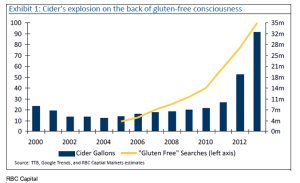
Cider sales and interest in gluten free as reported by CSP Daily News

If you can’t fight ’em, join ’em

Two other interesting pieces of information came my way that suggests continued, if not accelerating, growth for cider.

First, the beer folks are coming on board. Angry Orchard Cider by Boston Beer is a major player as are the products from MillerCoors – Crispin, from ABI – Stella Cidre and from Heineken – Strongbow. The big beer players sat out the craft beer phenomenon and have been playing catch up, so I suppose they don’t want to make the same mistake with cider.
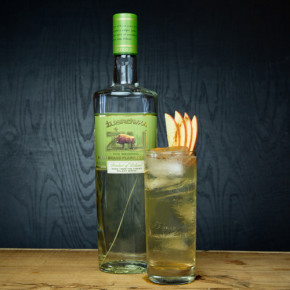
The Count of Żubrówka: 1.5 oz of ZU; .75 oz Amaro Montenegro; .5 oz Lemon juice; 4 oz hard apple cider

Second, I came across an interesting piece in Liquor.com that had some mouth-watering drinks with the delicious combination of ZU Bison Grass Vodka (Żubrówka) and hard apple cider. If you’re not familiar with Żubrówka, you ought to try it.

Will cider continue its growth? I certainly think so. But, at roughly an estimated 2 million hectoliters vs. beer’s 250 million, it has a long, long way to go.

“Surely the apple is the noblest of fruits.” — Henry David Thoreau, Wild Applesapples-sea-cider1
 

Leave A Comment

Casamigos Tequila Joins Sidney Frank Importing Company

Suggested price of $44.99 for the Blanco and $49.99 for the Reposado
Casamigos ultrapremium Blanco and Reposado

A celebrity owned tequila joins a beverage alcohol powerhouse

Sidney Frank Importing Co. (known for Jägermeister and the creators of Grey Goose Vodka) has been named the exclusive importer of Casamigos Tequila. The brand is owned by actor/director/producer George Clooney, nightlife entrepreneur Rande Gardner and real estate mogul Mike Meldman.

Usually, I don’t think very highly of celebrity owned or endorsed spirits products but this one sounds to me like a winner.

The previous winners — few and far between

I can only think of a few such products that have made it with dozens falling by the wayside. The top of the list is P Diddy and Ciroc. He has a stake in the brand and works hard at marketing it. Add Dan Akroyd and Crystal Head Vodka to the list – while not a home run, it has a presence and a following. Bringing up the rear is Skinny Girl, which came out of the starting block strong with Bethany Frankle, but seems to me to be languishing.

I can’t think of any other successes and the list of failures and wannabes is very large. (See my January 9, 2013 and August 21, 2010 blogs for the full obituary list.)

Will this one make it?

In my opinion, yes.

First, Sidney Frank Importing Co. (SFIC) is a significant player in the booze business with the infrastructure; sales and marketing players; and distributor network that’s top of the game. The gents running it are seasoned veterans and brand builders and so, put a double check mark next to trade marketing box.

But, the consumer is the ultimate judge and most critical component of brand success. Casamigos will need to challenge some pretty tough top shelf competition including Patron, Don Julio and, strong newcomer, Avión (my personal favorite). Oh, and let’s not forget Mr. Diddy’s new tequila venture, DeLeon Tequila.

What are some of the key elements of successful new entries?  Awareness, curiosity, discovery and willingness to try.

Imagine this… you’re in a bar with friends and someone says, “Hey, let’s have some tequila.” Someone else says, “Great idea, I’d like to try that new George Clooney tequila.” Another says, “Oh, I love George Clooney, great actor and seems like a decent, down to earth guy. Let’s buy a round.”

So… thanks to SFIC’s clout, the bar or restaurant will have Casamigos in stock. And, thanks to George Clooney, the consumer is very likely to try the brand.

In the brand building equation, if there is uniqueness and relevance (Clooney and tequila) awareness will very often lead to trial.

The most important elements in the equation, however, are brand adoption and loyalty (sustained usage). If the quality of the tequila is high and Mr. Clooney helps in the promotion, I think the brand will be around for the long run.

So, move over Diddy, there may be a new player in town.

George Clooney, Rande Gerber and Michael Meldman at the Sidney Frank national sales meeting.


Leave A Comment

Is There a Bubble in your Craft Beer?

Will the growth of craft breweries continue? Or, will the bubble burst?

There’s lots of press lately (Time, USA Today, Beer Business Daily) with both pro and con as to whether the craft beer industry is here to stay or if the bubble will burst.

Bubble? What Bubble? Take a look at this chart:

Growth in breweries
Number of Breweries over the last 126 years

According to the Brewers Association, the number of breweries at the end of 2013 reached over 2,700, the highest level since the 1870s. Despite the growth, American craft brewers account for only 9% of the beer category in the US. But, Craft beer production was up 9.6% in 2013 while overall beer production fell 1.4% according to CNBC as reported by Buffalo Trace Newsletter.

What’s a craft beer?

Micro beers
Craft Beers — just a few.

According to the Brewer’s Association — “An American craft brewer is small, independent and traditional.” They go on to describe some concepts related to craft brewers such as: small brewers, emphasis on innovation, made from traditional ingredients, among other things.

I’ve got a better definition — craft beers are more flavorful, with more unique styles and brands and just taste better than mainstream beers.

Even the big boys see the “beer handwriting on the wall” and have been getting into that segment with what can only be called “crafty” beers, according to a recent article in Time. Check out these brands and who owns them: Blue Point, Goose Island, Shock Top and Red Hood (AB-Inbev) Blue Moon, Leinenkugel and Killian’s Irish Red (Miller Coors).

Among the definitions of a craft beer, mentioned above, is size. And in this case, size matters — a brewer must be independent, which means that less than 25%of the craft brewery is owned or controlled by an alcohol industry member who is not themselves a craft brewer. In other words a wolf in sheep’s clothing can’t be a craft brewer member of the Brewers Association. But, it can be crafty.

What are the market segments of craft breweries?

Making beer
Craft brewers doing their thing

Here’s where it gets interesting. Half (50%) of the craft breweries in the US are Microbreweries and another 44% are Brewpubs. (Here are some precise definitions.) So, in effect, and by definition, the vast majority of craft brewers are small businesses perhaps akin to Mom and Pop operations.

But, they are much more than that. They are entrepreneurs with a passion for making quality, flavorful beer without the restrictions that large organizations impose. They understand how to meet the needs of changing taste preferences among consumers. In fact, a recent article in Beer Business Daily had this as a headline in their Nov 13, 2013 edition — “Wine and Craft Beer now in Direct Competition.” It’s based on a report by a consulting firm that compares craft beer to wine.

What about that bubble?

The study reported by Beer Business Daily suggests continued growth for craft beers based on: “shifting demographics (the rise of the Millennials), consumers’ desire for quality, diversity and authenticity as well as unprecedented innovation in brewing, marketing and packaging.” They further predict that the craft beer market will double since it is still early days in the “premiumization” of beer.

Hey, what about all those brewpubs that comprise the craft beer market, won’t many of them fail? I suppose many will but I also suppose that there will be others to take their place. According to Business Insider the majority of New York restaurant startups fail in five years. Does that mean that the restaurant “bubble” will burst?

Finally, Bart Watson, Economist at the Brewers Association, has an interesting article that gets at the heart of the so-called bubble issue. His central argument, in my view, is that craft beers at roughly 10% of beer consumption have a long way to go. That is, of course, so long as consumers continue to favor full flavored beers over light lagers. I don’t know about you, but I’m on board for the long run.

Second, remember that earlier I mentioned the inroads into craft by the big multi-national brewers? Here is what Bart has to say on the subject: “The fact that global players are diversifying into their own full-flavored product lines and investing in or buying up regional brewers proves the solidity of the consumer base on which craft sits.”

So far as I can tell, the only bubble in craft beer is in the glass.

(Many thanks to the Brewers Association for allowing the use of the chart and to Bart Watson for his insights.)


Leave A Comment