The Columbian Exchange – Ever Heard of it?

One of the most important events in history

The Columbian Exchange (sometimes called the Grand Exchange) was the exchange of goods and ideas from Europe, Africa, and Asia with goods and ideas from the Americas. An historian named Alfred Crosby was said to have coined the phrase in 1972, describing the exchange of crops and livestock between the New World and the Old World.

From the Savory Spice Shop blog.

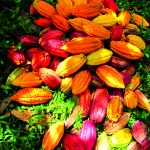
For example, the New World received such staples of our diet as citrus, apples, bananas, onions, coffee, wheat and rice. In exchange, the Old World received such plants as maize, tomato, vanilla, cacao and potato.

In terms of influence consider this:

Before Columbus discovered the Americas, there were no potatoes in Ireland. By the 1840s, the Irish Potato Famine caused deaths and massive emigration. Tomatoes came to Spain from the New World and from there to Italy and forever changed the culinary style of the country.

More than just food

So far as livestock is concerned, most of the exchange went from the Old World to the New World, including horses, pigs, cattle, chickens, large dogs and cats. Not many animals went the other way, with the notable exception of the turkey. Oh, and let’s not forget that when it comes to diseases, the Old World sent far more than it received – from measles to malaria.

What does this have to do with booze?

Ah, glad you asked.

A few weeks ago, a reader of this blog named Desmond Nazareth, who lives in India, contacted me to tell me about his company – Agave India Industries Ltd. Turns out that Mr. Nazareth is an entrepreneur, a graduate from the prestigious Indian Institute of Technology, Madras and is producing authentic artisanal spirit made from Agave Americana. If you look at the list of New World to Old World exchanges, the agave plant is right up there.

Desmond Nazareth and an Indian Agave plant.

He can’t call it tequila or even mescal due to appellation requirements but if it looks like a duck, walks like a duck, swims like a duck – you get the idea – it must be a duck.

Mr. Nazareth is arranging for me to see and taste his product and I’ll get back to you. I’ll also tell you how the agave plant got to India and about his extraordinary spirits enterprise.

So stay tuned.


Leave A Comment

Diströya: A Unique New Spiced Spirit

King Magnus is set to conquer the shooter market
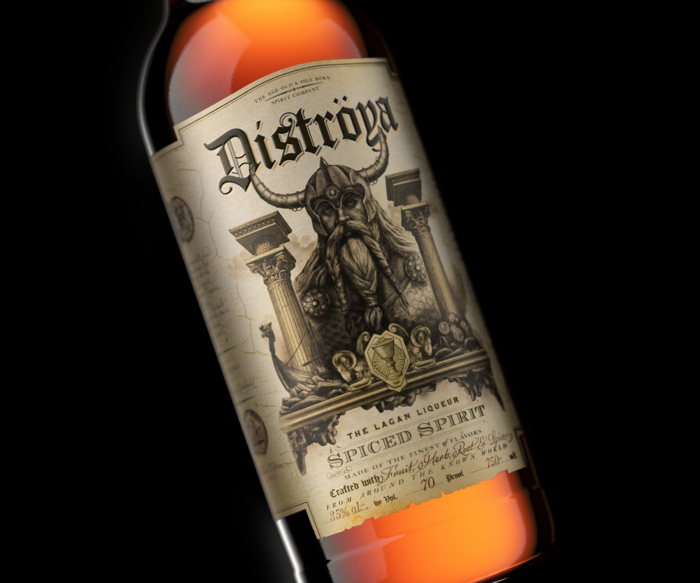
Diströya Spirits. The Dragon's Share.
Diströya Spirits. The Dragon’s Share.

Diströya Spirits, Inc. is focused on building a trilogy of unique spirit flavors, each with it’s own story. First up: “The Dragon’s Share,” based on a mythological and fun story of a spiced spirit created by the Viking King Magnus.

A recent article in Epicurious, had this to say: “The Vikings might have bludgeoned you on the head with a club, but Diströya, a Viking-based 70-proof spirit, takes a rather more mellow approach when it assaults your senses.”

The back-story

I met the owner of Diströya Spirits a few years ago. He was (and still is) a reader and follower of this blog and contacted me for some advice about the product he planned to launch. I get these types of calls and emails very often but, this time, it felt different. Scott Raynor, the owner, is an impressive guy. He’s a musician (when he has time to work that craft), an ex-bartender and among the most tenacious and innovative booze business entrepreneurs I’ve met. He has a vision and the patience to see it through. (Disclosure: I continue to be a non-paid advisor to Scott.)

The product

According to Scott, Diströya has less sugar and a lot more mystery than other liqueurs, uh, shooters. “There’s blood orange on the nose and entry, rounded out with vanilla, almond and cinnamon in the middle, finishing with the crispness of ginger and citrus,” he explains. “It’s lighter than a lot of liqueurs, and not cloying.”
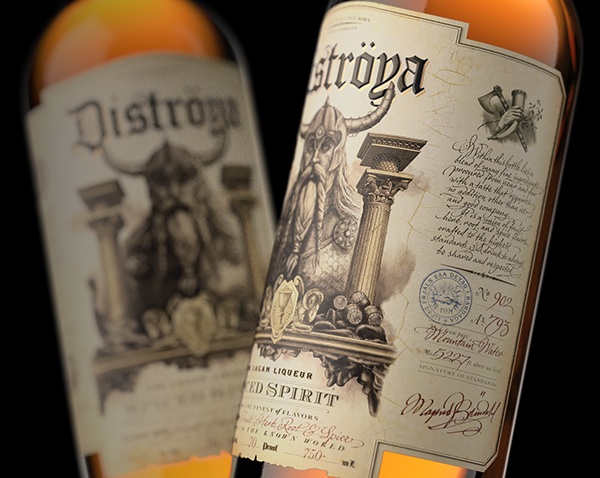
Diströya Label
Diströya Label

While he describes his product as a liqueur, which is its official TTB classification, such a booze product by any other name is still a shooter. In fact, he cites his competitive set as Jägermeister, Fireball, Kraken and others. But, Scott is savvy enough not to put his fledgling brand in a box and reports that bartenders are using it in mojitos, as a Ginger Viking (a Moscow Mule) and in other cocktails. It sells for $19.99 for a 750ML.

I’m well past the shooter stage and have a limited repertoire of cocktail preferences, so I enjoy it on the rocks. It’s pleasant tasting, smooth and makes me want to plunder and pillage. It’s all that Scott says it is.

The people

Despite the absence of meaningful resources, Scott’s contagious enthusiasm, industry knowledge (self taught) and likeability, has attracted an all-star team of spirits industry mavens in sales and marketing. Add to that some outstanding designers and illustrators. In particular, he worked with
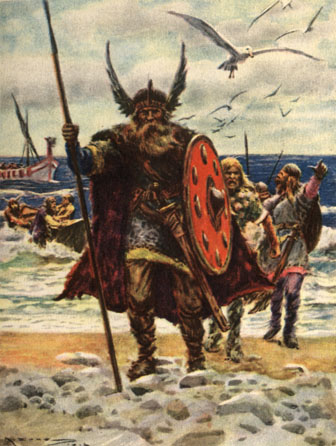
Friendly vikings on a cruise.

Chad Michael, a gifted designer who recently opened his own studio after working for a well known design firm. Also involved was Steven Noble, the illustrator for Kraken rum and Espolon tequila who collaborated in rendering the King Magnus icon.

He’s managed to do, on a shoestring budget, what the big spirits boys cannot do – form a team, launch a product and build a brand. And, he’s doing it the hard way.

What’s happening now?

Diströya is currently independently distributed in Denver. They are meeting with major distributors in the fall and expects to secure one. The brand is definitely getting traction in bars and stores. But, as is the case with nearly all indie startups, money is an issue.

So what does an enterprising new breed spirits maker do? Scott is going the conventional route of looking for investors, with some success I might add. But, in addition, he’s using crowd sourcing and has launched a Kickstarter campaign. You can find it here. Check it out, for a few bucks, one day you’ll be able to say you invested in Diströya Spirits.

What I think is particularly brilliant about the Kickstarter campaign is that at the same time as he is raising some money, he is building awareness.

Did I mention that he’s smart?

Come on… contribute a few bucks.
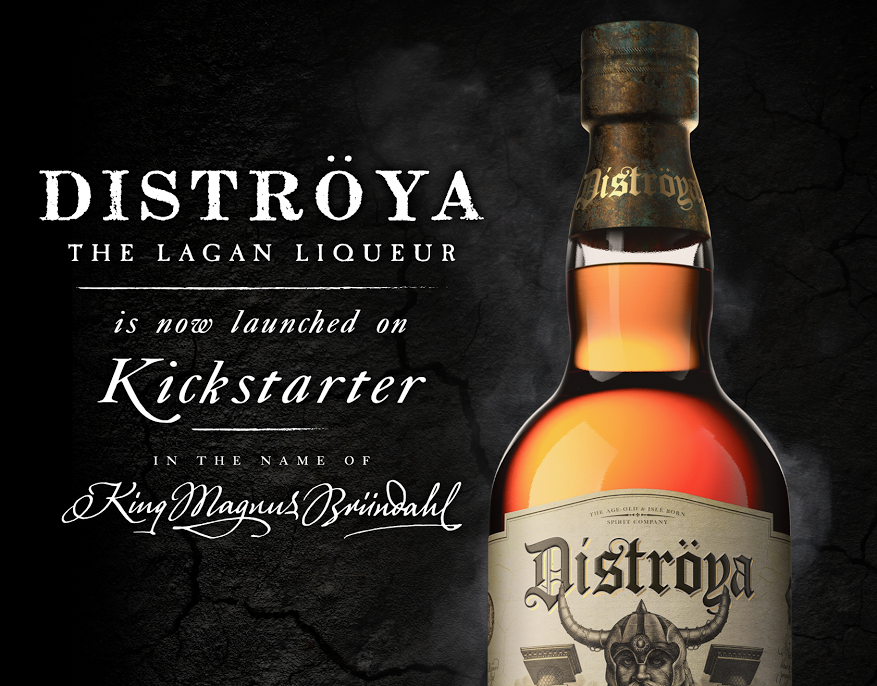
The Kickstarter campaign


Leave A Comment

Solbeso: A New Spirit from the Tropics

Introducing a new brand and new category of distilled spirit

UnknownSolbeso (derived from the Spanish for Sun and Kiss; “Kiss of the Sun”) is the first premium, distilled spirit made from cacao fruit. At 80 proof, this product has created a new category that is currently considered by the TTB as a Distilled Spirits Specialty. But it’s way more than that.

Imagine this: You’re in Peru visiting farms growing cacao on behalf of a chocolate venture. You discover that after the cacao pods are harvested, the beans are collected but the pulpy, tasty cacao fruit is thrown away. They tell you that the fruit oxidizes very quickly and soon starts to ferment so nothing is done with it. For most of us, that’s the end of the conversation.

Not for Thomas Higbee and Thomas Aabo, the founders of Solbeso. If Whiskey comes from grain, vodka from grain or potatoes, tequila from agave and cachaça from cane – why not create a new category from cacao fruit. Which is exactly what they did.

The aromatic fruit comes from family farms and co-ops throughout Latin America where cacao production has been going on for centuries. In fact, up until the arrival of Europeans, the people of Mesoamerica fermented the fruit into a low proof mead-like beverage. (In case you don’t know, tequila’s origin is pulque, which comes from an agave plant with a similar history among Mesoamericans.)

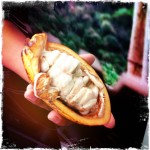
The Thomas’s decided to ferment and distill the “delicate, citrusy sweet pulp” into a spirit. By the way, the fruit bears no resemblance to the dark and bitter cacao bean, which is used to produce chocolate. Solbeso has no chocolate taste whatsoever.

So, what does it taste like?

I like it a lot. It’s a very unique taste that I enjoyed on the rocks with a lemon twist. To me, it has a slight citrus taste with an ever so slight aroma of chocolate. Definitely more complex, with a soft finish as compared to vodka consumed the same way. Unlike vodka, which is masked by the flavors you mix it with, Solbeso “plays well with others” and enhances the cocktail ingredients. You know it’s there but it doesn’t overpower the drink like tequila, cachaça or pisco .

A new spirit and a new brand

Where does it come from?

Here’s the part I love. Similar to grapes, cacao fruit is influenced by terroir and as a result, it can come from a variety or areas in the tropics (between the Tropics of Cancer and Capricorn) but currently from farms in Peru and Ecuador. Like grapes, it can come from other areas that meet the terroir requirements. In addition, they use a specialized strain of yeast that ensures consistency from region to region.

What about cocktails?

Thomas Higbee talks about the versatility of the taste and I’ve mentioned its enhancement to cocktails. Believe it or not, it makes a great Manhattan – they call it El Conquistador – made with sweet vermouth and bitters. (A Manhattan from a white spirit? What is this world coming to?)

The most interesting drink is the Picante No. 2 made with muddled jalapeño and fresh lemon juice. (See Recipe)

 Where to find it?

Picante No. 2: 2 parts Solbeso, 1 part lemon juice, ¾ part simple syrup, 2-3 jalapeño slices. Muddle jalapeño with fresh lemon juice.

Solbeso sells for $40 for a 750ml bottle. It’s available at select retailers, restaurants and bars throughout NYC and Miami. You can find locations on their website. While distribution is limited, I think it will grow over time. The brand — as the saying goes — has legs (longevity).

What’s the outlook?

From what I can see, the Thomas’s have the knowledge, horsepower and entrepreneurial drive to make Solbeso a huge success. After all, those consumers who love to discover new products don’t often get to see a new category being created.

At the same time, their biggest challenge might be what category is it in – Distilled Spirits Specialty (TTB), New World Spirits (the name of their company) or something else — DrinkUpNY referred to it as Cacao Spirit.

I don’t think it matters. Consumers drink brands not categories.


Leave A Comment
1 8 9 10 11 12 23