Would getting lung cancer, and getting rid of it while Tales was going on sound like him?
Gaz and I have known each other and been friends since the 1990s. More recently, we have become business associates in matters pertaining to the role of bartenders in brand building and business development. Together we launched Worldwide Bartender Database
We speak often and a short while ago he told me that during the course of a medical exam, the doctors found a spot on his lung that needed to be removed.
I freaked out. But he was particularly and unusually calm about the matter.
Got me to thinking… was this real? Was he pulling my leg? Or was he up to his old, attention getting tricks.
Now, before you think me cold and heartless, let’s examine Mr. Regan’s shenanigans:
In 2001 he started Cocktails in the Country, a bartending course believed to be the only bartending program in NY that used real spirits, as opposed to colored water.
By 2007 Jim Meehan, Dave Kaplan, Don Lee, H. Joseph Ehrmann, Jacques Bezuidenhout, Jamie Boudreau, Jared Brown, Anistatia Miller, Joaquin Simo, Jonathan Pogash, Naren Young, Philip Ward, Robert Hess, Sammy Ross, Toby Cecchini, Toby Maloney, and Willy Shine, among many others had all taken the CitC course.
In 2008 he started wearing eye-liner. (That’s right… among other reasons, he claimed it helped him make the point with bartenders that eye-contact with customers across the bar was an important element of ‘mindful bartending.’)
In 2009 he changed his name so he, like Prince, could be known as “The Bartender Formally Known as . . .”
In 2010 he started the Finger-Stirred Negroni Craze, which captured the world’s attention. Not long after, he had his finger cast in stainless steel and made into a stirrer.
And now, in order to create a buzz, gaz didn’t go to Tales of the Cocktail this year. Choosing instead to have half of his left lung ripped out.
So, you’ll forgive me if I was a tad skeptical.
“Well, in all truth” says gaz, “I didn’t have much of a choice in this one cos, according to my doctors I had a tiny pea-size lump of very aggressive cancer in there, but I couldn’t help but make a big deal of it, cos I’m known for never missing a chance to shock the world.”
Truth of the matter is that, after his operation, tests were performed, and gaz has been declared to be totally cancer free, and he’ll be out on the road again after he spends a couple of weeks being spoiled rotten by Amy his wife.
“I have to get back out there to make the money I missed out on by pulling this particular stunt,” says gaz, “So, if you doubt, for a second, that a two-time cancer survivor with hardly a tooth in his head, only half of a tongue and half of one of his lungs is up to the task, get in touch with me at The Worldwide Bartender Database and I’ll show you how it’s done.”
In truth folks, gaz has been laid up and concerned but now that he’s in the clear, this blog post was his inspiration. It’s his way of… well… back to being gaz regan.
All I can say is: Twasn’t my fault, Mum… He put me up to it.
So, forgive us if we had a bit of fun at f**ken cancer’s expense.
It was announced recently that Republic National Distributing Co (RNDC), and Liberation Distribution (LibDib) have formed a strategic alliance and will be working together.
I consider this a huge development for the wine and spirits industries and I was anxious to learn what it means for the future. I very much admire Tom Cole of RNDC and Cheryl Murphy Durzy of LibDib and was thrilled to have an exclusive interview with both of them. The three of us talked about how this development came about and what it means for the distribution of both large and small brands.
RNDC is the second largest distributor in the US, operating in 22 markets with a long history dating back to before Prohibition. It is an organization built on the strong foundations of three family-owned companies. What I’ve always admired about RNDC is their values, marketplace effectiveness, and people you enjoy working with.
LibDib is the first technology company to offer a 3-tier compliant model that provides an option for the growing number of makers (suppliers/manufacturers) that are entering the market. Launched in June, 2016 and they describe themselves as: “A wholesale distributor of alcoholic beverages enabled through a web and mobile platform.” (An earlier article I wrote about LibDib is here.)
As reported by Wine and Spirits Daily, LibDib suppliers will be able to use RNDC’s logistics and expand throughout their footprint, while RNDC will have access to LibDib’s technology and data. To me, it is also a union of the traditional and new routes to market.
So, what does this mean?
Tom Cole, CEO RNDC
According to Tom Cole:
“When I first learned about LibDib, I was fascinated by the commitment to the 3-tier system…I believe in and am a passionate protector of that system, so the LibDib approach offering effective online ordering, satisfies the need for small makers that are having difficulty getting to market…”
Cheryl Durzy, CEO LibDib
Cheryl added:
“We use the term evolve — How are we going to evolve the 3-tier system to meet the needs of the modern consumer and what they are looking for in spirits and wine.”
In effect, LibDib will have the opportunity to expand from its current operations in New York and California and ultimately operate in RNDC’s 22 markets. They’ll be able to tap into RNDC’s advanced logistics to deliver craft products to buyers in all available markets.
In turn, RNDC will have access to LibDib’s technology and data collection, thereby enabling them to further expand their value and services. In effect, they will be offering their large supplier organizations access to the rapidly changing market place by offering insights and actions into the new and evolving consumer.
What I think is particularly appealing, is that RNDC, which doesn’t currently operate in NY and CA, will have access to those markets in a new and unique way.
The problem being solved
Let’s start with craft spirits products and small brands.
IWSR has produced the Craft Sprits Report 2018, which looks at the current and future growth of craft spirits in the US.
They report that in 2017, the craft spirit volume share of all spirits sales was 3.3% which is 7.5 million 9-liter cases and up 25% from the previous year. They forecast that by 2022, craft spirit brands will account for close to 20% of all spirits and more than double its share at 7.9%.
In terms of value, craft brands accounted for 4.6% share of all spirits and, by 2022, they forecast it to be 10.4%.
What really caught my eye was this statement: “To put the current size of craft spirits into perspective, the 7.5m case total is roughly equal to the entire U.S. brandy category in 2017.”
So, what’s the problem?
The route to market available to large brands is not generally available to small brands, particularly start up ventures or fledgling brands from small craft or other distilleries. The result is a hodgepodge of distribution solutions. Some large distributors will take on these brands but more as an exception than a rule. Come on… you would do the same if you ran a spirits and wine distributorship. It’s a volume driven business that largely depends on mass and mainstream brands. As a distributor put it to me once, “hey, you want my sales folks to stop focusing on a proven winner to sell your maybe-it-will-make-it brand?”
As a result, small spirits companies often rely on wine and beer distributors. Both wine and spirits companies will aim for importers with a distribution network or companies like MHW LTD or Park Street Imports (both with distributor licenses in a few key markets). All in the hope for an effective route to market and in compliance with the 3-tier mandatory system.
The large company conundrum
Developing new products/brands and getting them to market is difficult for the large makers as well.
Imagine you’re a major player in a leading spirits and wine company. You look around and, while your mass brands are doing okay, the craft/small batch brands are eating away at your volume. The cocktail focus has won the attention of bartenders and consumers alike and your mainstream brand is in danger of becoming yesterday’s newspaper.
Your options are to stick your head in the sand and ignore the changing market place and consumer behavior. That won’t work because your kid needs braces so your bonus might be in jeopardy. So, you figure out that you need to enter the fray and either start acquiring some of those fledgling brands or build your own through your innovations group.
Now you have another problem. The distribution and business models are based on large volume and you don’t want your people, or your distributor’s people, focusing on your new “baby” while ignoring the brands that need the attention. You can either launch a small brand-focused business unit or find a better, more cost-effective solution.
As many of you know, at Seagram I ran new products at one point and this venture of combining the clout of RNDC and the LibDib model would be just what I needed to succeed. In short, this strategic alliance between a top distributor and a company focused on small brands would have made my mouth water by allowing me to get into the small producer game, while still keeping my eye on the (big brand) ball.
How this came about
My hats off to Tom Cole who has the vision and smarts to see where the industry is going and to move his business in an advantageous direction. And to Cheryl, whose tenacity and foresight will reap benefits to her innovation.
I’ve known Tom a long time and he’s a visionary, always attuned to the changing marketplace, and willing to explore new opportunities and directions. It’s no surprise, therefore, that when he learned about LibDib, he looked into it.
Cheryl and her family ran a small winery in northern California and learned firsthand what a nightmare it is for a small company to get to the shelves of restaurants, bars, and stores. She created LibDib as a solution. In a relatively short period of time the company has attracted large numbers of makers and retail (bar and store) accounts in New York and Los Angeles. LibDib has become a viable and growing go to market resource.
After a number of exploratory phone calls, they met at the WSWA and learned that they had a great deal in common — the yearning to find a solution for new brands, a shared vision of the future, the support for the 3-tier system, entrepreneurial focus, and approaches to business management. Back and forth conversations and due diligence followed and a year later RNDC invested in LibDib and they are now partners.
What’s next?
There is much work to be done to maximize the potential of this venture and 2019 will involve some beta testing in NY and LA. Beyond that they will be exploring efforts on a state by state basis. There’s a lot to learn and this is a work-in-progress, undoubtedly with a slow and steady pace, making sure all the kinks are worked out. As Tom put it, “We will do things thoughtfully and correctly and increase our likelihood success.”
So far as I’m concerned, this development changes everything.
I’ve known Tom Bulleit since the 1990s and it was under my watch at Seagram that Bulleit Bourbon was developed and launched. Tom is a terrific guy, a real gentleman, and a smart businessman.

I saw some Impact Databank sales information the other day and among the top 10 super-premium bourbon brands, Bulleit is second only to Maker’s Mark in case sales at 1.2 million 9-liter cases (Maker’s is at 1.5 million), but Bulleit’s growth from 2016 to 2017 was 12.7% compared to maker’s 4.7%.
What’s even more impressive is that in 2000 Bulleit sold 180,000 cases while Maker’s Mark sold 1.4 million. At this rate of growth, it is likely that Bulleit Bourbon will surpass Maker’s as the leading selling brand.
So, the brand’s remarkable achievement has been the result of Diageo’s and Tom Bulleit’s efforts. Its launch and positioning in the bourbon market was due to the folks at Seagram.
Its start has always been an enigma to me and I set out recently to get the full story and to refresh my memory.
Let’s go Down Seagram Memory Lane
If you’ve read my book (forgive the shameless self-promotion), you know that Seagram was a whisk(e)y company in a world of vodka, tequila and other non-whiskey products. Starting in the early to mid 90s, the company acquired the distribution rights to Absolut, and at the same time, Captain Morgan and Crown Royal were growing by double digits each month. By the mid to late 1990s Seagram had consolidated its whisk(e)y portfolio to Canadian Whiskies (Crown Royal, VO and its line extension), Seagram 7 Crown, and Scotch brands (Chivas Regal, The Glenlivet, and other single malt whiskies).
All other whiskey brands were sold or let out to pasture. This Included such terrific brands as Weller, Benchmark and my current favorite, Eagle Rare. The sole exception that comes to mind is Four Roses, which was doing very well as a bourbon brand in Japan but languished as a blended American whiskey in the US.
The puzzle to me as I look back on it is, with the portfolio changing and growing and many whiskies being sold, why did Seagram want a fledgling bourbon with a pretty awful package (at the time)?
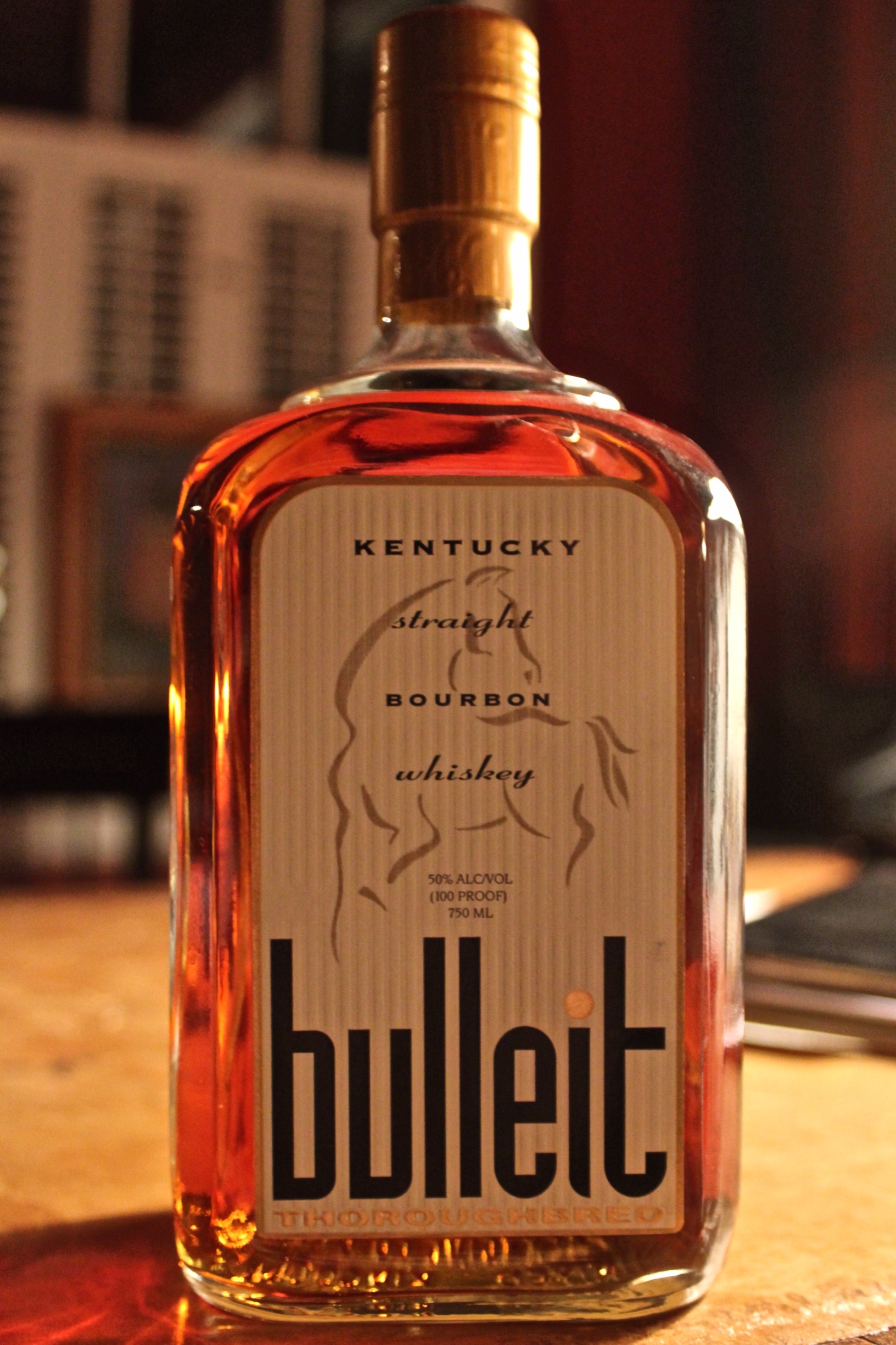
The old Bulleit bottle
There’s another piece of the equation that may partially shed some light on this.
In 1995, Seagram bought 80 percent of the shares in entertainment conglomerate MCA Inc. for $8 billion. The company was now in a new business and Edgar Bronfman Jr. focused his attention there. As a result, the owner “overwatch” returned to Edgar M. Bronfman (the Chairman) assisted by John Bernbach, a long time Edgar Jr. friend, an advertising and media executive, and a Bronfman/Seagram advisor.
How Bulleit Came to Seagram
John played a crucial role. At dinner one night with an attorney friend from a prominent NYC law firm, John was told about Tom and the brand. He naturally assumed that since Seagram did not have a bourbon, Bulleit would make a strong addition to the overall portfolio. He brought the idea to both Edgar Jr. and the Chairman.
Both Bronfmans were said to have some reservations. The younger Bronfman was not happy with the packaging (see photo) while the Chairman had some reservations about the taste. But, both liked the idea of a bourbon in the House of Seagram.
But why? Bourbons had been removed from the fold, Crown Royal was on fire, Glenlivet and other single malts were doing nicely, and the company’s focus was on Absolut and the commitments to the Swedish owners.
There are lots of conjectures as to the answer. Perhaps Edgar Jr. was prescient and saw bourbon’s return as an opportunity. Maybe he wanted to show investors and the company that, despite the entertainment industry involvement, the spirits business was still top of mind. Conceivably the Chairman, now returned to the forefront of the booze business, was excited by the idea of a bourbon product that was outstanding.
My guess is that when John brought in his team (copywriter and art director), he showed the Bronfmans what the brand could become. Edgar Jr. in particular loved the work of these two gents.
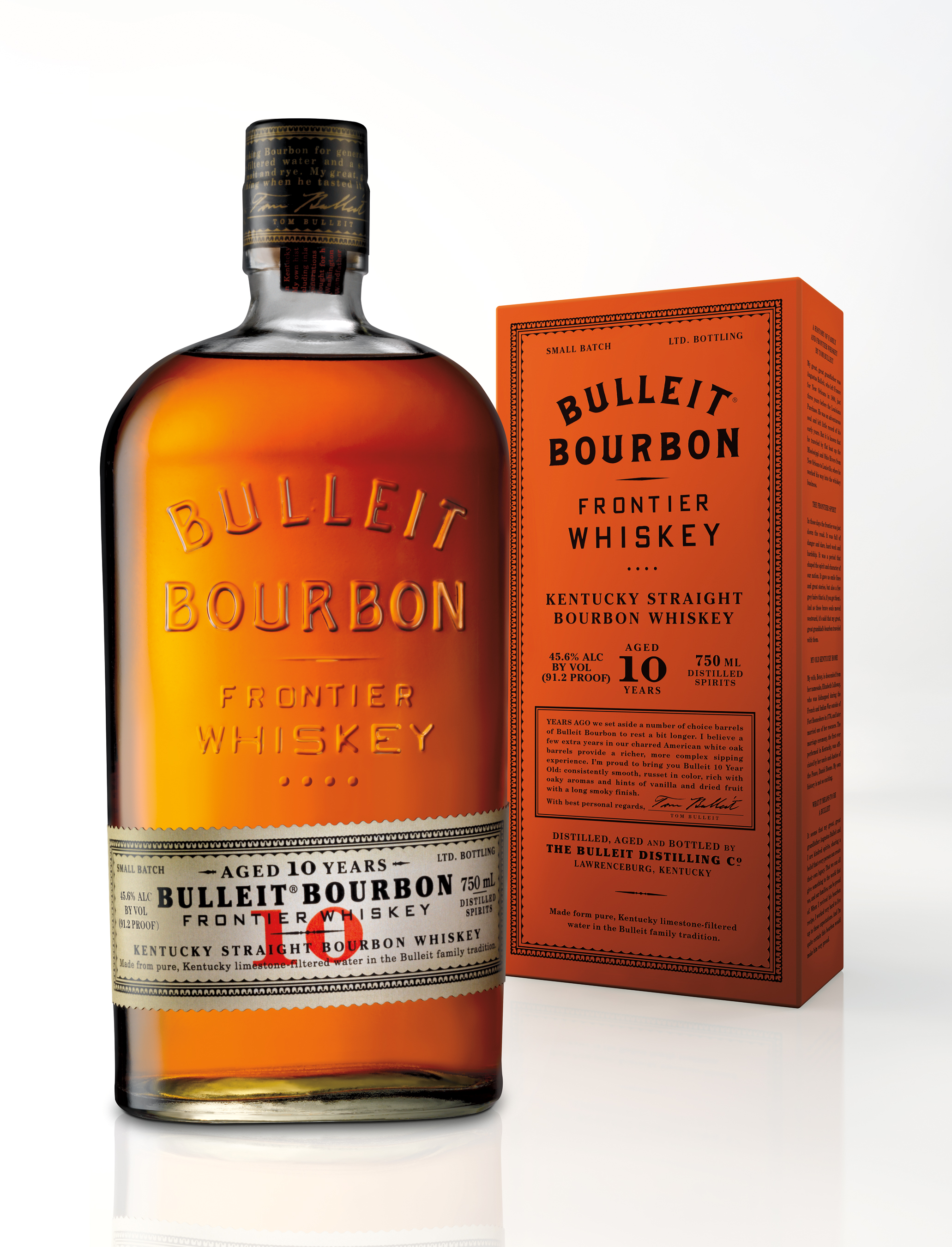
Bulleit 10 year old bourbon
Chuck Cowdery—writer, blogger, historian, marketer, and arguably the most knowledgeable bourbon maven on the planet—has written more than anyone about Bulleit. So, I’ll let him provide a brief history as reported on his blog:
Bulleit bourbon was launched in 1995, the brainchild of Tom Bulleit, a Kentucky lawyer who, through his legal work, learned a lot about the growing international market for American whiskey. He contracted with the Buffalo Trace Distillery in Frankfort, Kentucky, to make it. A few years later, he moved his operation over to Seagram. They created the current bottle and reformulated the product, moving its production to the Four Roses Distillery in Lawrenceburg, Kentucky.
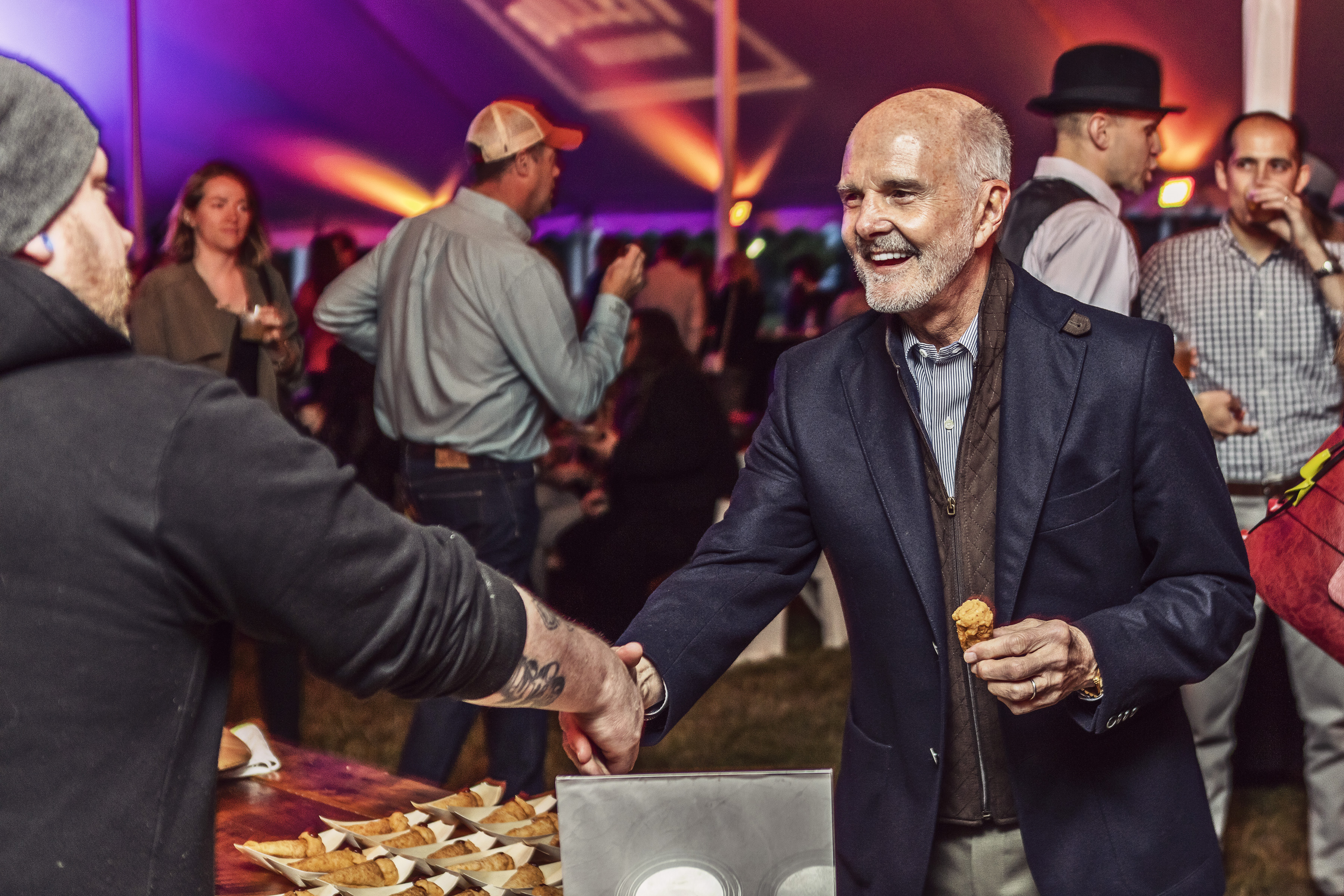
Tom Bulleit
From the moment Tom walked through the door, and up to the closing of the Seagram door, Tom was a key player in the development of the brand. He worked with the production folks on the recipe, with the agency on the brand’s positioning, and with marketing/packaging on the look and message of Bulleit.
To me, this was a bit unusual. While Seagram often welcomed brand acquisitions, with the exception of Absolut, the attitude was often (to paraphrase) “thanks, we love your brand, here’s your check, we’ll take it from here, and here’s the door…” But, all of us from the Bronfman’s on down, welcomed Tom’s involvement.
There’s probably a couple of reasons for that, mainly due to Tom’s personality and approach—he’s smart, has the brand in his DNA, a team player, and overall terrific person to work with. Neil Gallo, who ran the day-to-day development of the brand, told to me recently that Tom would often say to Seagram folks something like, “here’s my suggestion, use it or not as you see fit.” His ideas were almost always accepted.
From my standpoint, I loved Tom’s “outsider” views and the way he interacted with our people.
Tom Bulleit
The Bulleit Product
Whether there was a Bulleit Bourbon product on the market or otherwise available to be bought in the 19th Century, was irrelevant to us. Tom’s proposition was 1) the brand traced its origin to Augustus Bulleit (great-great-grandfather of Tom) and 2) with strong brand credentials, the brand could be a winner. We totally agreed.
The production folks were energized by the fact that they would be working on a new whiskey (a bourbon no less) and would be able to use the outstanding bourbon stocks they had. According to Art Peterson, who was VP of Quality Assurance and Technical Services, the team presented samples from mingling bond stocks from inventory. These went to Tom and the master distiller for approval. Ultimately, as was the case with all Seagram products, the final approval of the liquid came from the Chairman.
Tom, for his part, had his ancestors recipe in mind—a high rye content bourbon. What was produced was two-thirds corn and one-third rye. (The bourbon corn requirement is 51%). Today the brand’s recipe is very similar—68% corn, 28% rye, and 4% malted barley.
Here’s how the Bulleit website describes the product:
Inspired by his great-great-grandfather Augustus Bulleit, who made a high-rye whiskey between 1830-1860…
The Concept and the Packaging
John’s Bernbach’s team (with Tom and Neil’s involvement), came up with a simple yet powerful message. This isn’t just a bourbon, this is a Frontier Whiskey. A powerful slogan followed— “When men were men and whiskey was bourbon.” I loved it, approved it immediately then brought it to Edgar Jr. for his final okay.
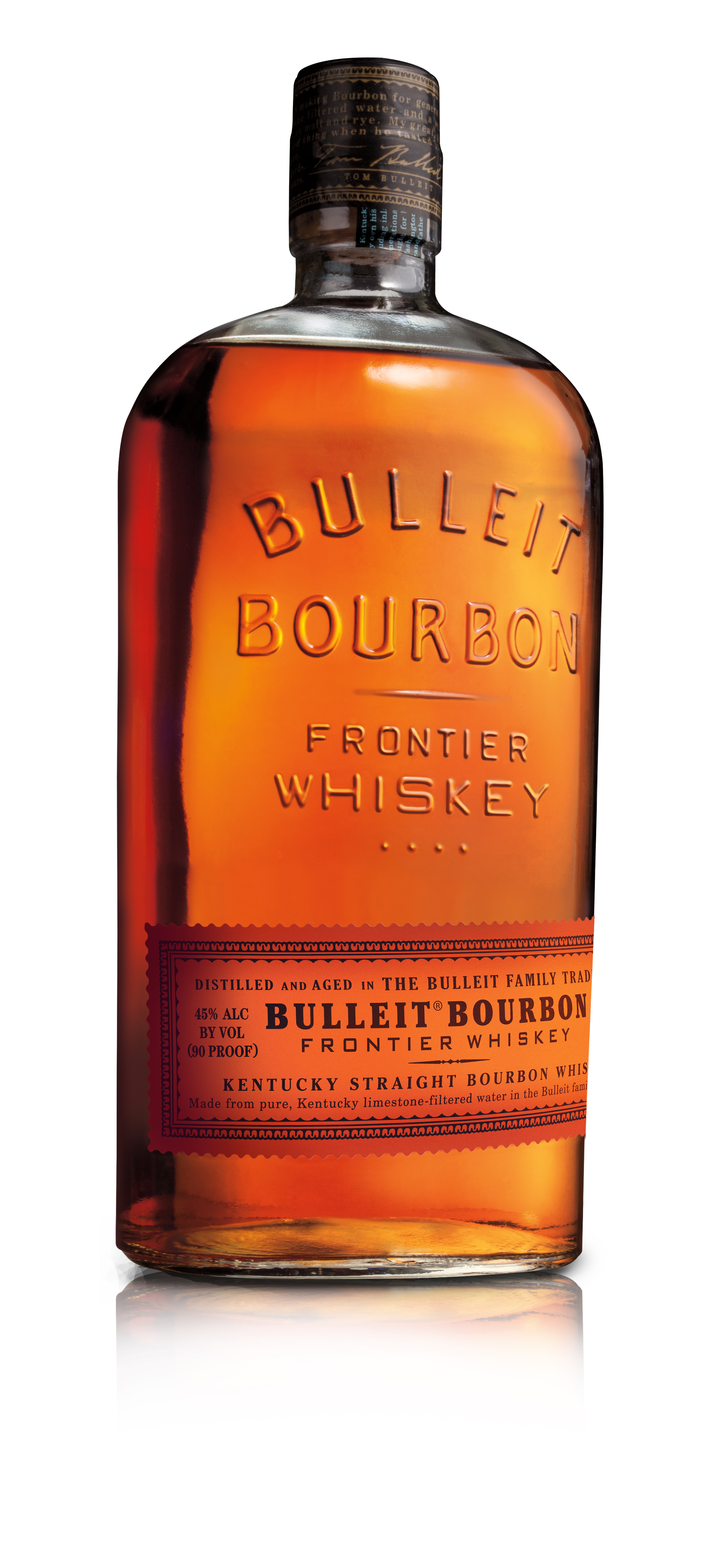
The slogan is gone but the Frontier Whiskey is still prominent in the current Bulleit packaging.
To me, the Bulleit packaging that was developed by Sandstrom Partners in Portland Oregon captured the concept perfectly. All the elements were there—a flask shaped, apothecary-like bottle, embossed branding, cork closure and, a minimal wraparound label that is slightly askew as though it was hand applied.
About that label… It was put on deliberately misaligned because it fit the imagery and positioning of the brand. It is part of the brand’s personality. However, in almost all operating committee meetings someone from production would invariably say something like this: “Great news Arthur, we fixed the label. It’s now perfectly straight.” This “great news” was always met with a groan and a request to leave it alone.
The Reactions
Not everyone in the organization loved or cared about Bulleit. Most of those in sales welcomed the brand since it had the backing of the owners or because they saw an opportunity in the bourbon business. At the same time, there were many who felt that Bulleit detracted focus and attention from the phenomenal growth of Crown Royal—a known winner vs. an upstart. Besides, there were other brands in need of focus such as Absolut and Captain Morgan, both recognized winners.
The brand limped along from the mid-1990s until the end of the decade. Then the lights went out as Seagram was sold to Pernod-Ricard and Diageo. The brands were split up and Diageo acquired Bulleit Bourbon.
The situation for the brand changed appreciably. According to data I’ve seen, the returning growth of bourbon began in the mid-2000s. Unlike Seagram, Diageo, while strong in scotch, did not have much going for it in American whiskies, particularly bourbon. Dickel and Rebel Yell hardly fit the bill to compete with the rapidly growing brands. As a result, Diageo had nothing to lose and much to gain by pushing Bulleit and its unique package and positioning. I’m told that Diageo’s sales folks loved the brand and strongly focused on it.
Today
In 2017, to meet the demand of Bulleit, Diageo built a distillery in Shelbyville, Kentucky which will produce 1.8 million proof gallons annually, with the opportunity to expand further over time. It’s on a 300-acre campus with barrel houses at a cost $115 million.
At the current rate of growth of the brand, I wouldn’t be surprised if the expansion were to happen very soon.
* * *
Lessons Learned
1. The role of focus
Seagram had strong and rapidly growing brands requiring concerted and sustained effort. Bulleit would have had to push itself to the forefront of the portfolio at the company. Even if Seagram had survived, I have my doubts as to whether Bulleit would be where it is today.
2. Managing a portfolio of brands
Diageo, seeing the emergence of a return to bourbon, had the good sense to back Bulleit at the expense of George Dickel (a Tennessee whiskey) and Rebel Yell (which was ultimately sold to Luxco in 1999). In short, Seagram’s roster of brands had no real room for Bulleit while Diageo did.
3. Hey marketing folks—don’t overthink it
I think there is a temptation among marketers to show relevance and authenticity by claiming a brand’s recipe dates back to 1830. It was smart to go a different route—just being inspired by Augustus Bulleit is sufficient. As a consumer, I care less about a brand’s history and background and more about what it is today.
* * *
I’d like to thank the following people who helped refresh my memory or otherwise corrected my recollection in writing this article. These included Neil Gallo, Rob Warren, John Bernbach, Greg Leonard, Sam Ellias, Art Peterson, and, of course, Tom Bulleit.