Would getting lung cancer, and getting rid of it while Tales was going on sound like him?
Gaz and I have known each other and been friends since the 1990s. More recently, we have become business associates in matters pertaining to the role of bartenders in brand building and business development. Together we launched Worldwide Bartender Database
We speak often and a short while ago he told me that during the course of a medical exam, the doctors found a spot on his lung that needed to be removed.
I freaked out. But he was particularly and unusually calm about the matter.
Got me to thinking… was this real? Was he pulling my leg? Or was he up to his old, attention getting tricks.
Now, before you think me cold and heartless, let’s examine Mr. Regan’s shenanigans:
In 2001 he started Cocktails in the Country, a bartending course believed to be the only bartending program in NY that used real spirits, as opposed to colored water.
By 2007 Jim Meehan, Dave Kaplan, Don Lee, H. Joseph Ehrmann, Jacques Bezuidenhout, Jamie Boudreau, Jared Brown, Anistatia Miller, Joaquin Simo, Jonathan Pogash, Naren Young, Philip Ward, Robert Hess, Sammy Ross, Toby Cecchini, Toby Maloney, and Willy Shine, among many others had all taken the CitC course.
In 2008 he started wearing eye-liner. (That’s right… among other reasons, he claimed it helped him make the point with bartenders that eye-contact with customers across the bar was an important element of ‘mindful bartending.’)
In 2009 he changed his name so he, like Prince, could be known as “The Bartender Formally Known as . . .”
In 2010 he started the Finger-Stirred Negroni Craze, which captured the world’s attention. Not long after, he had his finger cast in stainless steel and made into a stirrer.
And now, in order to create a buzz, gaz didn’t go to Tales of the Cocktail this year. Choosing instead to have half of his left lung ripped out.
So, you’ll forgive me if I was a tad skeptical.
“Well, in all truth” says gaz, “I didn’t have much of a choice in this one cos, according to my doctors I had a tiny pea-size lump of very aggressive cancer in there, but I couldn’t help but make a big deal of it, cos I’m known for never missing a chance to shock the world.”
Truth of the matter is that, after his operation, tests were performed, and gaz has been declared to be totally cancer free, and he’ll be out on the road again after he spends a couple of weeks being spoiled rotten by Amy his wife.
“I have to get back out there to make the money I missed out on by pulling this particular stunt,” says gaz, “So, if you doubt, for a second, that a two-time cancer survivor with hardly a tooth in his head, only half of a tongue and half of one of his lungs is up to the task, get in touch with me at The Worldwide Bartender Database and I’ll show you how it’s done.”
In truth folks, gaz has been laid up and concerned but now that he’s in the clear, this blog post was his inspiration. It’s his way of… well… back to being gaz regan.
All I can say is: Twasn’t my fault, Mum… He put me up to it.
So, forgive us if we had a bit of fun at f**ken cancer’s expense.
Who can argue that wood plays a vital role in the taste of your favorite whisk(e)y. In fact, in a Vinepair article it’s estimated that “wood is responsible for 60 to 75 percent of the taste of a finished whiskey.”
More than that, wood is the star of whiskey making with various types of oak, casks that previously held other spirits (even wine), different toasting techniques, even double barrel resting. Maker’s Mark 46 goes one step further and adds wood staves to the barrels. Described as follows: “The innovative wood-stave-finishing process starts with fully matured Maker’s Mark at cask strength. We then insert 10 seared virgin French oak staves into the barrel and finish it for nine weeks in our limestone cellar.”
A new and unique approach
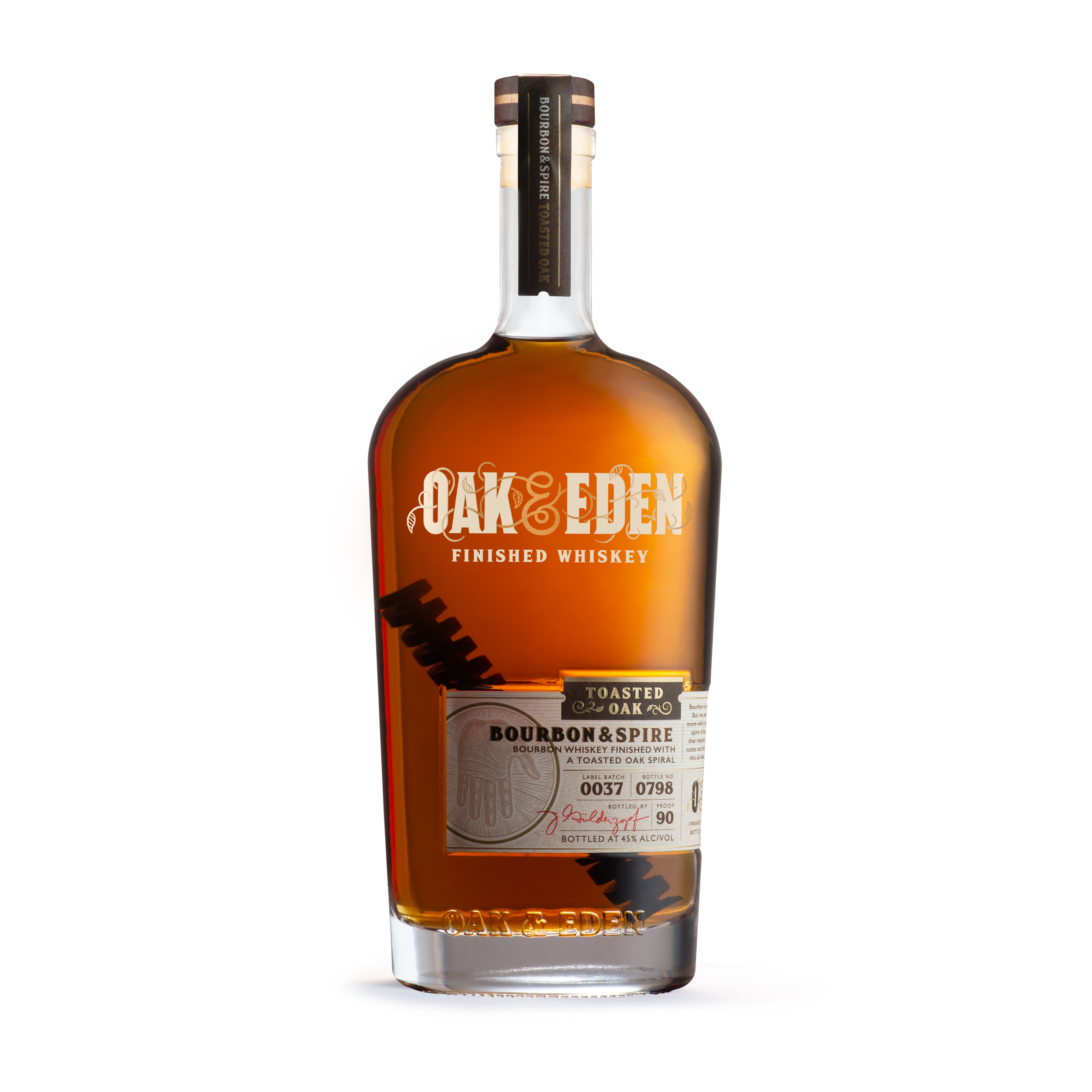
The Sanctified Spirits Company, a startup in Texas, which owns the Oak & Eden brand of bourbon and rye whiskeys, uses a spiral piece of wood (referred to as a spire) inserted into the bottle. This patent pending technique, which they call in-bottle finished whiskey, consists of a 5-inch spiral cut piece of wood from the same species of wood as the barrel. They rest the product for 6 weeks and sell the whiskey with the spire in it.
While I am not a whiskey taster/reviewer, I’m an avid American Whiskey fan, so I tried it to see what it tastes like. The one I tried was Bourbon & Spire (“Bourbon Whiskey finished with a toasted oak spiral”). I loved it.
Here’s how Brad Neathery, Co-Founder and CMO, describes the process:
“The technique allows us the ability to create millions of combinations of whiskey expressions through the selection of the base spirit (bourbon, rye, wheated bourbon, single malt, etc.), the wood type of the spire (American Oak, French Oak, Cherry, Ash, etc.), the fire level we expose the spire to (light toast, medium toast, char, etc.), and the spice or liquid we can infuse the spire with (wine, coffee, rum, beer, etc.).”
About the company
The company was founded by Joe Giildenzopf (CEO), his brother Jamie Giildenzopf (Co-Founder) and Brad Neathery (CMO) in 2017.
When I got a bottle and while doing my research for this article, I noticed the references to God, Christianity and Creation. For example, on the back label it says, “The name pays a gracious homage to both the perfection of the creator who breathes his unique spirit into us, and the wood that infuses our other favorite spirit, and it’s complex flavors.” So, I asked Joe and Brad about this aspect of the company.
“We are Christians. That being said, this is not a Christian whiskey. We’re not attempting to proselytize with this whiskey. We do however, because of our faith and our understanding of Scripture, see the world through that lens, including the production of whiskey. When He turned His attention to making mankind, he did not speak us into existence, he instead used his hands. Taking the elements of the earth and forming a being… breath(ed) into us, which is translated in Hebrew (as) ‘inspire.’ … We call the whiskey Oak & Eden, in-bottle finished, inspired whiskey. And because that great creation story began with God in the garden, we named our product Oak & Eden. Oak is emblematic of wood in the bottle. Eden is the perfection of God’s creation.”
I mentioned these references as religious overtones. Joe corrected me — “I see them as a perspective on the world.”
Makes sense to me. These folks are passionate in what they do, spiritual in how they approach business and it comes together in an innovative, great tasting product.
The products
The current line up consists of Bourbon & Spire, Toasted Oak; Rye & Spire, Charred Oak; Rye and Rumba, Rum Soaked Oak; Bourbon & Vine, Cabernet Steeped Oak.
There’s an excellent review of the brands and tasting notes in this Forbes article.
Brad told me about their newest efforts:
“By the time that you’ve written it, we will have released a collaboration project with Rahr and Sons Brewing, in Texas. They’re a beer company. We want to have two products, a rye infused with their IPA, and a bourbon infused with their Scottish ale.”
The products are all 45% AbV (90°) and sell for $40 for the Bourbon and Rye. Oak & Eden buy their whiskeys from a number of sources, including Midwest Grain Products (MGP). They curate, buy the whiskey, blend, bottle, and finish it in-bottle with the spire.
They launched in May of last year and Oak & Eden is available in TX, CO, KY, MI, OK, and LA. This year they anticipating being in GA, KY, IN, GA, NY, IL. They expect to be national by the end of 2020.
They sold 3,200 (6-pack) cases in eight months in Texas, among the top selling new items in the state. They have a national contract with RNDC (Republic National Distributing Company).
Oak & Eden has three patents, according to Joe:
“We have an exclusive license to the patent for the manufacturing of the spire. We don’t own that, but our cooper does and we have that exclusive license through the life of that patent. We also have a patent on in-bottle finishing, which is the technique of finishing the spirit in a closed glass container with a spiral cut piece of wood. And, then we have a design patent on the bottle and the way in which the spire rests in the bottle. So yeah, we’ve got pretty good IP wrapped around it.”
I asked about their interest in making this innovation available to others. Their answer is they talk about it but have not as yet come to any conclusions, much less a strategy.
The marketing approach
Speaking of strategy, one thing I did not ask about but has since occurred to me, is why they launched so many line extensions from the outset. If it were me, I might have opted to launch with two then gradually roll out the others over time or with selected markets. I would be concerned about stretching the resources too thin.
But I suppose it makes sense. There’s a need to show the range of products using this new technology, an account doesn’t need to purchase all of them, and perhaps they have the financial and other resources to “blast” in rather than “soak” in.
The article cited above in Forbes, raised an important question that I am sure is on the mind of many of you — legitimate innovation or marketing gimmick? The writer’s conclusion:
“I think this is a legitimate innovation and one to get excited about … As a finishing technique, the spire offers a lot more flexibility for finishing whiskeys and dramatically expands the options for different finishes beyond the usual approach of barrels that previously held another liquid.”
I tend to agree. But, the verdict is up to the consumer.
“Diageo sells portfolio of brands to Sazerac,” read the headline of the press release. It went on to say that among the brands acquired were Seagram’s VO and VO Gold. I found this fascinating on a number of levels. First, you might say that these brands have seen better days and why would a company like Sazerac, with a full and lush portfolio, want these brands. On the other hand, Sazerac has done amazing things with brands they acquired from Seagram (think Eagle Rare and Fireball to name only two) so, a revival of the Seagram VO franchise would not be unusual or impossible.
It was under my watch at Seagram that VO’s decline accelerated and VO Gold was created. So, among others, I contacted John Hartrey and Art Peterson (both of whom you have met before on this blog) who played important roles with those brands, back in the day. I also spoke with Drew Mayville, who worked on the creation of VO Gold and was the 4th and last Master Blender at Seagram, and is now the Master Blender at Sazerac.
{By the way, as I write this, I’ve learned that Sazerac has introduced “Mister Sam” Whiskey — a Blend of Sazerac’s American and Canadian Whiskeys and a tribute to the Seagram founder, Sam Bronfman. The blend was created by Drew Mayville.}
The importance of VO to Seagram
Let’s start with the fact that the New York Stock Exchange symbol for Seagram was VO. That speaks volumes. Next, consider the fact that The Chairman (aka Edgar M. Bronfman) earned his stripes at the company working on VO.
It was always a great whiskey, a 6-year-old Canadian blend and the aspiration of Seagram 7 drinkers looking for more and, yes, better.
I recall, after taking over the position of U.S. marketing head, being summoned to a lunch with The Chairman in his private dining room. This was during the time that Edgar Jr was involved in Hollywood. I think, in retrospect, the purpose was to let me know that he was back in control and was in charge during this interregnum. Really? As though I didn’t know? All I recall from that lunch was that the butler asked me what I wanted to drink and I looked at him in amazement. With the exception of a special occasion, drinking at lunch was not for me. When I told him so, his look was beyond amazement as he said, “The Chairman generally has a VO before lunch… I’d suggest you do the same.”
Some believe that the term VO stood for “Very Own” and, according to the Master of Maltwebsite, “It is said the blend was created after a post-prandial conversation (during or relating to the period after dinner or lunch) amongst the Seagram family; the letters “VO” might well stand for “very own”, as in, their very own blend…”
Art Peterson told me the following story about the family’s commitment to VO:
“When Edgar Senior and Charles (Bronfman) were running the Canadian operation, they learned that due to some production or maturation difficulties, the blenders were unable to match the character of the current VO production to the standard. So, Charles and Edgar made the decision to stop shipping the brand until they solved the problem. That meant that there were shortages in the marketplace, but they were determined that no shipments would be made until that problem was solved.” (Despite my griping about the owners, they were all about quality and doing the right product thing, no matter what.)
Most interesting to the VO story is the packaging, notably the ribbon on the bottle. I’ve been told that it was the racing colors of a Bronfman owned horse. More about that ribbon in a moment.
But tastes changed and the brand slipped
By the early 1990s, consumer liquor preferences had leaned to clear spirits in general and vodka in particular, so whiskies (with a few exceptions) suffered volume declines. At Seagram, Seagram 7 Crown was huge and a bar staple so its losses were manageable. At the other end, Crown Royal, whose appeal was to top shelf drinkers and strong regional support, actually grew in volume. In part, this was a result of an upmarket line extension — Crown Royal Special Reserve. Seagram VO was awash in red ink and, while it held its own against the archrival Canadian Club, you didn’t want to be the brand manager who presented the sales and marketing results when there was a Bronfman in the room. As in… “our sales are way down BUT, our market share is up.”
The central question became, “What to do about VO.”
Enter the Consultants
The owners of Seagram loved to bring in consulting companies such as McKinsey or Boston Consulting Group — you know, highly paid outsiders who basically ask for your watch so they can tell you what time it is. I couldn’t help but wonder why they chose to go around the company’s employees. I often felt they thought, how smart can our people be, they chose to work for us didn’t they?
Among other things the consultant contribution to the brand was to “take the goodness away,” by eliminating what they saw as ‘unnecessary’ packaging elements. You know… what we in marketing and sales call “brand personality elements.” Among the cost saving victims was the VO ribbon.
VO after the package changes
The Answer…
…came from the toilers in the company, not the consultants. In so doing, we broke what classic marketers call the rule of line extensions — don’t line extend from a weak brand. Nonsense.
There were many reasons why an upmarket VO line extension made sense, including increased margin, additional VO facings in stores, a new face in the brand’s franchise and lineup, and more. And, the success of Crown Royal Special Reserve, gave us the impetus to try that tactic on VO. What did we have to lose?
So, VO Gold was born and, with the thumbing of our noses at the consultants, we put all the goodness in packaging back into VO Gold. Including the ribbon.
But the strength of the brand came from the blenders and the marketers. Here’s how Art Peterson described what happened with the product formulation:
“Drew Mayville was part of the team and in on the creation of the brand. What happened was that VO Gold was just an idea. We knew it had to be some kind of a premium VO, but true to VO characters. We started by discussing, ‘What could we do to improve VO?’ Well, one idea, of course, is you can use older whiskeys. We decided that we would focus on eight-year-old whiskeys. And then, ‘What can we do to VO to make it different but still recognizably VO?’ We decided to go with a whiskey that would be brighter. Also, some of the characteristics in VO that we liked were the fruity characteristics, and that came from having certain yeasts that we used in our rye whiskeys in the VO blend.”
The proof of the blenders’ success came in a letter to Art from Charles Bronfman:
“I have tasted VO Gold and it’s just fabulous!!! Best damn VO I have ever tasted, and as you know, I have tasted an awful lot of VO over the years. Nice going, my friend.”
VO Gold
What I especially enjoyed about Seagram was the team spirit and, in this case, how marketing worked hand in hand with the blenders and production to bring this brand to life.
Led by John Hartrey, the marketing folks came up with a totally unique idea; never done before but used by others afterward. They ran a program that centered on “meet the blender.”
What they did was communicate, through advertising and point of sale, a series of dinners in five different markets. It was a contest whereby “you and 20 of your friends” could win a dinner with Art Peterson, followed by an expert tasting with him. It was a huge success and VO Gold was on its way.
About that ribbon
John reminded me of a great story about the VO ribbon. It was removed because it required special equipment and was expensive to produce. Little did the geniuses at the consulting firm (or many of us) know that it played a role in the Viet Nam war. According to John:
“When we removed the ribbon, we got a letter from a Vietnam Vet asking why the ribbon was removed. He told us that during the war, the VO ribbon was referred to as a “short timers’ ribbon”. The idea was that when someone had a short time left on their tour (probably 30 days), he put the ribbon on his uniform so that everyone knew to protect him and get him home.”
Seagram’s VO and VO Gold now have a second shot at success. The best part is that one of the blenders who worked on the original products, Drew Mayville, is the current Master Blender for the new owners (Sazerac) of the brand.
Drew used a great expression when we spoke that really resonated with me, “A lot of companies want to meet consumer expectations. At Sazerac, we strive to delight the consumer.”
I can’t wait for it to come on the market.
Thank you John, Art and Drew for taking the time to talk with me about this.